
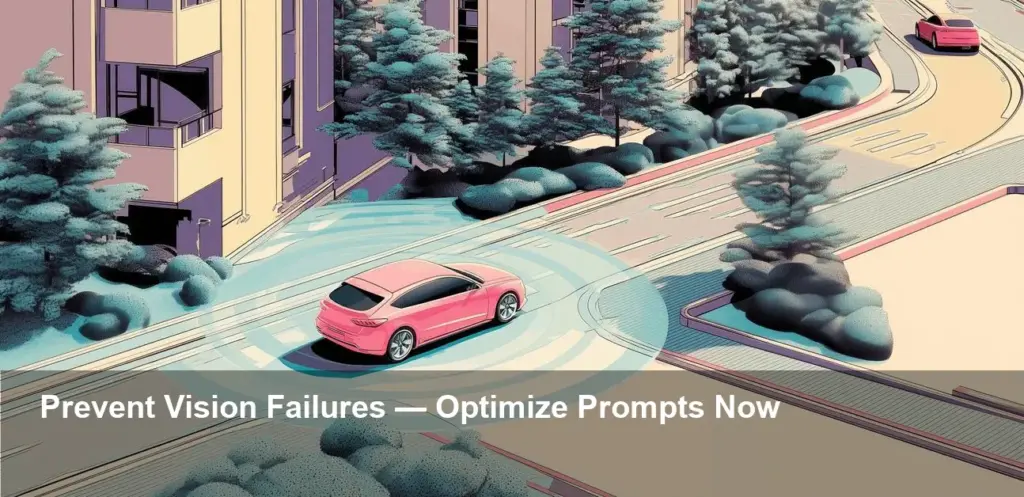
- Automatic prompt optimization reduces human trial-and-error in multimodal vision systems.
- Researchers demonstrated a self-driving car example that improves perception consistency and edge-case handling.
- Technique promises faster deployment, better safety margins, and lower annotation costs for autonomy teams.
Automatic Prompt Optimization: What happened
A recent piece on Towards Data Science outlines automatic prompt optimization for multimodal vision agents and illustrates the approach with a self-driving car example. The technique automates the search for effective prompts — the instructions or context fed to large vision-language models — so agents interpret camera, lidar, and map data more reliably without laborious manual tuning.
Why this matters for self-driving systems
Multimodal vision agents fuse visual inputs with language-based reasoning. In autonomous vehicles, a small change to a prompt or context phrase can change how a model labels objects, assesses risk, or prioritizes maneuvers. Manual prompt engineering is slow, brittle, and hard to scale. Automatic optimization addresses that fragility by programmatically finding prompts that produce robust, consistent behavior across scenarios.
How the method works (high level)
Rather than relying on human-crafted instructions, automatic optimization frameworks use search, gradient-free optimization, or reinforcement signals to evaluate candidate prompts against performance metrics. For a self-driving example, the system tests prompts across diverse driving clips — day/night, rain, occlusions — and selects prompts that minimize perception errors or unsafe decisions.
Self-driving car example
In the demonstration, the optimized prompts helped a vision agent better detect pedestrians in partial occlusion, correctly interpret unusual road markings, and reduce inconsistent lane-change signals. The result was more stable decision-making in edge cases that typically trip up hand-tuned systems. Although exact numbers vary by dataset and model, practitioners saw clear improvements in consistency and fewer critical misclassifications.
Implications and benefits
- Faster iteration: Teams can evaluate many prompt variants automatically rather than manually crafting each one.
- Improved safety margins: Reduced perception errors in rare or ambiguous scenarios can translate to safer behaviors.
- Lower costs: Less need for exhaustive labeling or trial-and-error reduces engineering time and annotation budgets.
Caveats and next steps
Automatic prompt optimization is a powerful tool but not a silver bullet. Robust validation, adversarial testing, and integration with end-to-end system safety checks remain essential. The community should standardize benchmarks for prompt robustness and measure real-world performance beyond lab datasets.
Bottom line
Automating prompt design for multimodal vision agents is emerging as a practical lever to improve perception and behavior in autonomous vehicles. For organizations building or evaluating self-driving stacks, incorporating prompt optimization tools could deliver faster improvements and a competitive edge — provided they pair automation with rigorous safety validation.
Image Referance: https://towardsdatascience.com/automatic-prompt-optimization-for-multimodal-vision-agents-a-self-driving-car-example/