
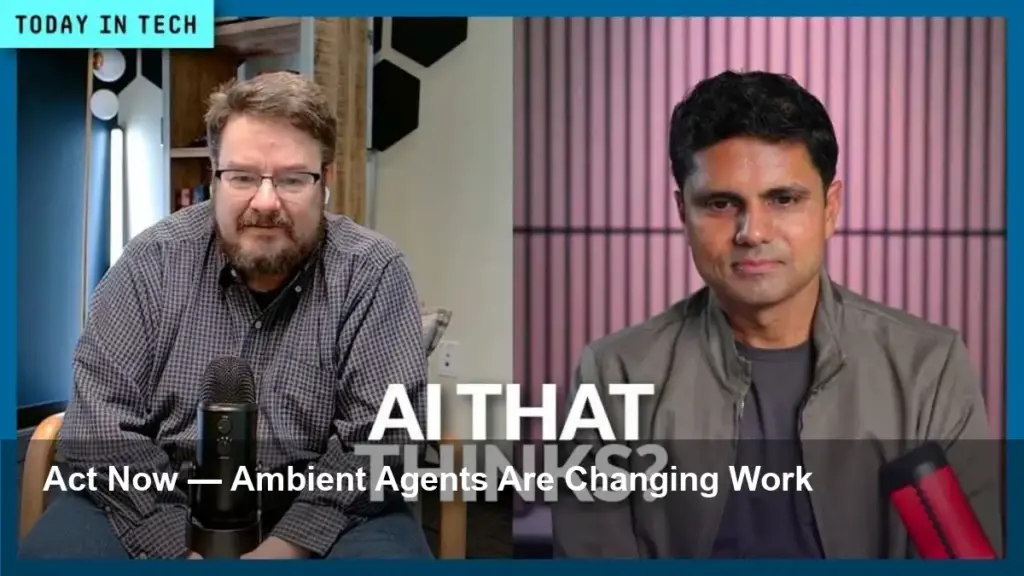
- Ambient agents are autonomous AI systems that act across apps and services to complete workflows, not just suggest actions.
- This next wave of AI shifts automation from passive assistance to active task execution, increasing speed and complexity of digital work.
- Early adopters see productivity gains — but risks around accuracy, control, and compliance mean governance is essential.
What are ambient agents and why they matter
Ambient agents are AI-driven systems that continuously monitor context (emails, calendars, documents, apps) and take actions on behalf of users. Unlike traditional assistants that make recommendations, ambient agents execute tasks: scheduling meetings, drafting and sending emails, reconciling invoices, or triaging support tickets. This shift — from “AI that suggests” to “AI that acts” — promises to redefine automation at work by embedding agency into systems.
How ambient agents work
At their core, ambient agents combine large language models (LLMs) with connectors to enterprise data and APIs. They parse intent from natural language and context signals, plan multi-step workflows, and interact with services to complete tasks. Key enablers include:
- Real-time context ingestion (inbox, calendar, CRM, collaboration tools)
- Action planning and orchestration layers that map intent to API calls
- Policy and guardrails for approvals, logging, and rollback
Practical examples
Use cases already emerging in pilots include:
- Sales: auto-drafting personalized proposals, updating CRM, and scheduling demos after a qualifying call.
- IT and ops: diagnosing alerts, running remediation scripts, and notifying stakeholders without human intervention.
- Finance: extracting invoice data, matching line items, and initiating payments subject to thresholds.
Risks, trust and governance
Powerful as they are, ambient agents introduce new risks. Acting autonomously means mistakes can propagate quickly: incorrect emails, unintended transactions, or privacy breaches. Organizations must balance speed with control. Critical governance measures include:
- Explicit approval flows and human-in-the-loop checkpoints for high-risk actions.
- Audit trails, explainability logs, and model-version controls to investigate behavior.
- Data access policies and least-privilege connectors to limit exposure.
How leaders should prepare
Executives and automation teams should run focused pilots with clear success metrics: time saved, error rate, compliance incidents. Start with low-risk, high-frequency tasks to build trust and iterate. Invest in integration platforms, role-based access, and monitoring to scale safely.
Ambient agents aren’t a future possibility — they’re an accelerating reality. Organizations that adopt them thoughtfully can unlock significant productivity gains, while those that ignore governance and change management risk costly mistakes. Act now to pilot, learn, and create guardrails before the technology starts acting across your stack without you.
Note: No social media embeds or YouTube videos were present in the provided source content.
Image Referance: https://www.computerworld.com/video/4115615/what-are-ambient-agents-why-ai-that-acts-will-redefine-automation-at-work.html