
- AI automation platforms are now mission-critical — choose wrong and productivity suffers.
- This list highlights 10 proven tools (2026) every team should evaluate, with quick pros and pitfalls.
- Includes low-code, RPA and developer-first options to fit different budgets and technical stacks.
- Act now: early adoption can yield competitive gains, while slow moves risk falling behind.
Top 10 AI Automation Software Solutions for 2026 — Executive Summary
As AI capabilities mature, automation platforms have split into three clear camps: low-code workflow builders, enterprise RPA with generative AI, and developer-first automation platforms. Teams that match business needs to the right category avoid wasted spend and stalled projects. Below are 10 solutions widely recommended in 2026 for different use cases.
Why this matters now
Many tools overpromise AI-driven outcomes; the difference is practical integration, governance, and extensibility. This guide focuses on platforms that deliver consistent ROI, integrate with common stacks, and offer governance features teams need at scale.
Top 10 AI Automation Tools (short profiles)
1. Zapier
Best for: Small to medium teams and fast prototypes. Zapier remains a go-to for simple triggers and AI-enhanced actions. Strengths include vast app library and ease of use. Beware: complex logic and enterprise governance are limited.
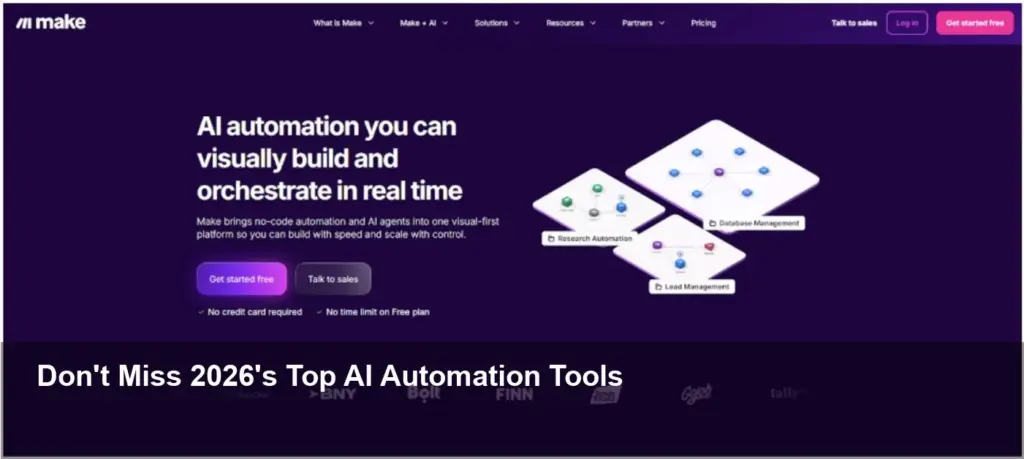
2. Make (formerly Integromat)
Best for: Visual builders that need advanced branching and data transformation. Offers more control than basic low-code tools but can get complex for non-technical users.
3. n8n
Best for: Teams wanting open-source flexibility and self-hosting. Strong for privacy-sensitive use cases and custom connectors. Trade-off: requires engineering resources for setup and maintenance.
4. Microsoft Power Automate
Best for: Enterprises invested in Microsoft 365 and Azure. Deep integration into Microsoft ecosystem and growing AI features. Pitfall: licensing complexity and potential vendor lock-in.
5. UiPath
Best for: Large-scale RPA with sophisticated unattended automation. Strong in regulated industries. Expect higher implementation costs and governance needs.
6. Automation Anywhere
Best for: Enterprise RPA with cloud-first deployments. Robust orchestration and analytics but can be heavyweight for smaller teams.
7. Workato
Best for: Complex enterprise integrations and citizen automation with IT governance. Highly capable, but pricing can be a barrier for smaller orgs.
8. Tray.io
Best for: API-heavy, customizable workflows. Developer-friendly platform for scalable integrations; less suited for non-technical users.
9. Pipedream
Best for: Developers building programmatic workflows with code and AI model integrations. Excellent for engineering-driven automation but not low-code friendly.
10. ABBYY Timeline (Process Intelligence)
Best for: Process discovery and process mining combined with automation insights. Use this to find automation opportunities before building bots; not a standalone workflow builder.
How to pick
Prioritize: (1) fit with existing stack, (2) governance & compliance, (3) ease of scaling, (4) clear ROI. Pilot early with measurable KPIs to avoid expensive rewrites.
Bottom line
AI automation can transform operations — but choosing the wrong tool is costly. Evaluate these 10 options against your data, security needs, and team skills. Move quickly: competitors are already automating the next wave of workflows.
Image Referance: https://aijourn.com/top-10-ai-automation-software-solutions-every-team-should-know-about-in-2026/