
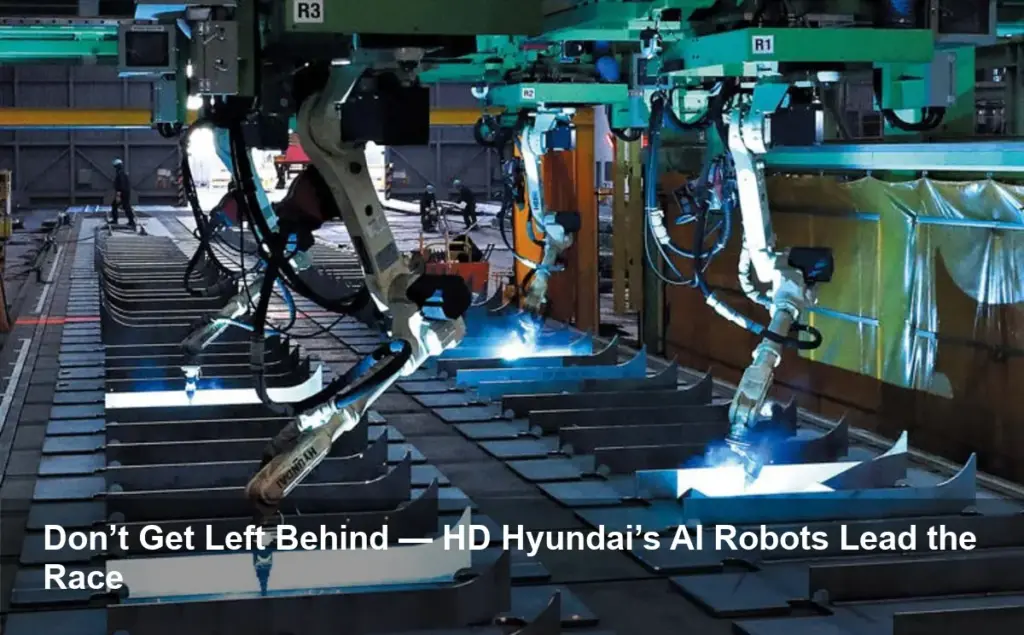
- Dozens of 1.5‑meter steel components were staged at HD Hyundai Heavy Industries’ Yongyeon Factory on Dec. 18 as four ceiling‑mounted AI robots began assembly.
- Robots now glide across the workshop floor to handle core ship‑floor components, increasing precision and automating repetitive tasks.
- The move highlights a broader shift toward AI-driven automation in global shipbuilding, with implications for productivity, worker safety and industry competition.
HD Hyundai Deploys AI Robots at Ulsan Yard
On December 18, inside the compact assembly area of HD Hyundai Heavy Industries’ Yongyeon Factory in Ulsan’s Nam‑gu District, a quiet but radical change unfolded. Dozens of 1.5‑meter‑long steel plates — core components for ship floors — were lined up in two columns, 80 centimeters apart. Four ceiling‑mounted robots glided over the materials, taking over tasks traditionally done by human hands.
What the robots do
The ceiling systems are equipped with AI controls that allow them to move precisely above the lined components, performing handling, positioning and process tasks that previously required multiple workers and significant manual alignment. The factory setup highlights how automation is being applied not just to heavy lifting but to fine positioning and repetitive assembly tasks that contribute to production bottlenecks.
Efficiency, consistency and safety
HD Hyundai’s move aims to boost consistency and reduce errors on the shop floor. Robots operating from overhead rails minimize the risks of worker injury associated with heavy steel handling and reduce human fatigue on repetitive operations. For an industry where dimensional accuracy and weld quality are vital, programmed machines promise repeatable outcomes and tighter process control.
Industry impact and competitive pressure
The introduction of AI‑driven robotics at one of the world’s largest shipbuilding yards sends a clear signal to competitors: automation is no longer experimental but operational. Shipbuilders that delay adoption may face longer lead times, higher labor costs and inconsistent output — risks that translate directly into lost contracts in a competitive market.
What it means for workers
Automation reshapes roles rather than simply eliminating them. HD Hyundai’s rollout suggests a shift toward higher‑skilled positions — robot operators, maintenance technicians and AI supervisors — even as routine manual tasks decline. The transition will require retraining and careful workforce planning to balance productivity gains with social responsibility.
Looking ahead
HD Hyundai’s implementation at the Yongyeon Factory is an early but significant example of AI integration in heavy manufacturing. As this technology spreads, the winners will likely be firms that pair automation with workforce upskilling and process redesign. For the rest of the sector, the message is stark: adopt or risk falling behind.
(Note: no embedded social media posts or videos were included in the provided source.)
Image Referance: https://www.msn.com/en-xl/lifestyle/shopping/hd-hyundais-ai-robots-revolutionize-shipbuilding-automation/ar-AA1TmkQR