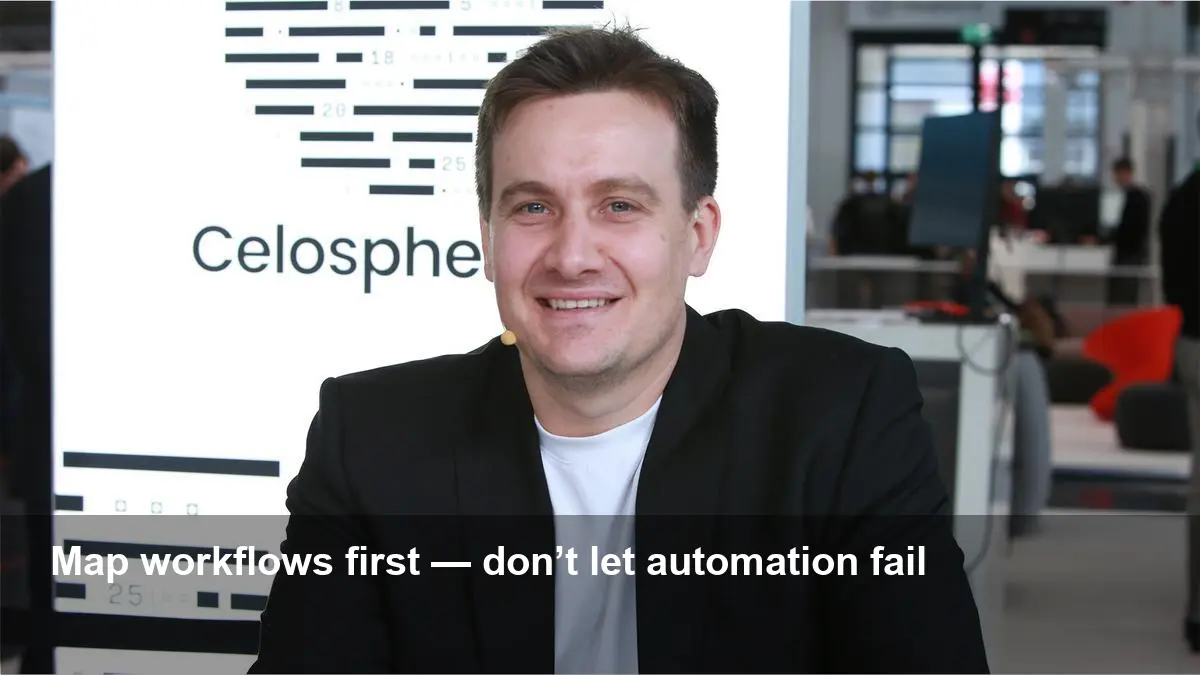
- Process intelligence combined with AI agents improves execution accuracy, trust and enterprise ROI.
- Experts say mapping workflows before automation reduces failures, compliance gaps and wasted spend.
- Governance, observability and human-in-the-loop controls are critical as agents take on complex tasks.
- Leading organizations are already piloting agent-driven automation to accelerate outcomes and avoid costly mistakes.
Process intelligence AI agents reshape how enterprises automate workflows
Enterprises rushing to deploy AI agents for automation are discovering a hard truth: execution quality depends on understanding the underlying workflows first. Process intelligence — the discipline of mapping, monitoring and analyzing business processes — is emerging as the critical foundation that turns agent-driven automation from a risky experiment into predictable, high-return operations.
Why process matters before agents
AI agents can act quickly, but when they operate on shaky or poorly documented workflows they create errors, compliance exposures and unpredictable costs. Process intelligence tools provide visibility into end-to-end steps, decision points and exceptions. That visibility enables engineers and automation teams to:
Key advantages
- Prioritize high-impact automations by spotting bottlenecks and frequency of tasks.
- Reduce agent misexecution by clarifying inputs, handoffs and edge cases.
- Establish measurable baselines for ROI, error rates and time savings.
Trust, governance and human oversight
Adoption of AI agents increases pressure on governance and observability. Process intelligence injects audit trails and behavioral telemetry so organizations can verify how agents make decisions. Human-in-the-loop checkpoints remain essential for high-risk workflows — approval gates, exception routing and post-action reviews help preserve compliance and build stakeholder confidence.
Best practices to adopt now
- Map processes before automating: use discovery tools to capture real-world behavior rather than relying on assumptions.
- Define success metrics: measure accuracy, cycle time improvement and financial impact to validate agent interventions.
- Layer governance: role-based access, explainability and rollback procedures reduce operational risk.
- Monitor continuously: implement observability for agents to detect drift, anomalies and performance regressions.
Realistic ROI and fast wins
Companies that pair process intelligence with AI agents report faster, more reliable automation outcomes. Quick wins typically come from automating routine, high-volume tasks after mapping exceptions, while more complex end-to-end processes require phased rollouts and tighter human oversight. The combined approach shortens time-to-value and reduces rework, improving enterprise ROI.
Bottom line
AI agents offer powerful automation capabilities, but without process intelligence they risk creating more problems than they solve. Organizations that prioritize workflow discovery, governance and continuous monitoring will unlock higher trust, safer execution and measurable ROI — and avoid the costly missteps experienced by early adopters who skipped this step.
Social embeds: None present in the source article.
Image Referance: https://siliconangle.com/2026/01/07/process-intelligence-ai-agents-celosphere/