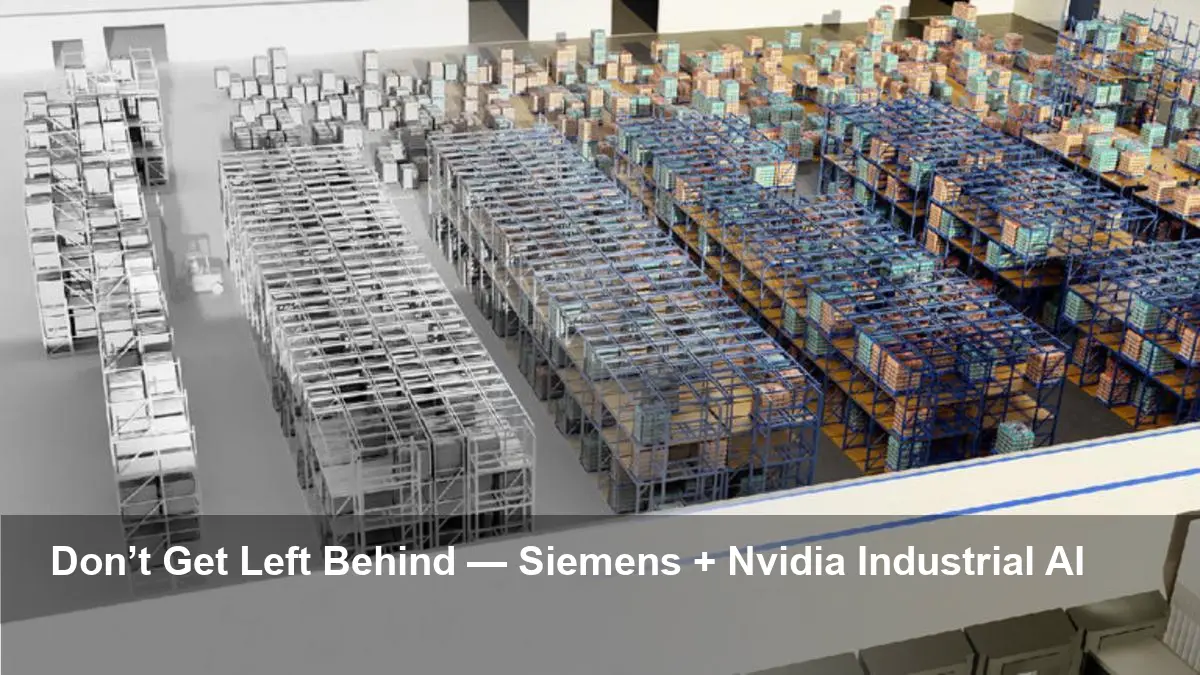
- Siemens and Nvidia are deepening their collaboration to embed AI into industrial production sites, simulation tools and electronic design automation (EDA).
- The partnership aims to accelerate design-to-production workflows, improve simulation speed and drive real-time analytics on factory floors.
- Industry leaders say adopters may seize competitive advantage — while laggards risk higher costs, slower innovation and operational vulnerabilities.
Siemens, Nvidia expand partnership to accelerate industrial AI adoption
What the announcement covers
Siemens and Nvidia have announced an expanded collaboration to integrate advanced artificial intelligence across Siemens’ industrial software and operational technology stack. The companies plan to apply AI at three core points: production sites, digital simulation and electronic design automation (EDA), aiming to compress design cycles, improve manufacturing yields and enable smarter, real-time decision-making on the shop floor.
How the integration will work
The expanded deal signals closer technical integration between Siemens’ industrial software portfolio and Nvidia’s AI platform and accelerated compute. In practice, this could mean AI models and GPU-accelerated inference embedded directly into simulation tools for faster virtual testing, EDA workflows that leverage machine learning to catch design flaws earlier, and analytics at production sites that predict failures and optimize throughput.
Benefits for manufacturers
For industrial customers, the collaboration promises measurable gains: shorter time-to-market due to faster simulation and validation, lower costs through predictive maintenance and reduced scrap, and improved product quality from AI-assisted electronic design. The combined reputations of Siemens and Nvidia also act as social proof, encouraging broader enterprise adoption.
Risks and concerns — why negativity matters
Despite the upside, there are legitimate risks. Heavy reliance on AI platforms raises concerns about vendor lock-in, data governance, cybersecurity, and workforce disruption. Companies that adopt too quickly without proper safeguards may face costly mistakes or regulatory scrutiny — a reminder that rapid technological change can also introduce new vulnerabilities.
Industry implications and FOMO
The move amplifies an already accelerating trend: industrial AI is becoming a baseline expectation. Businesses that delay integrating AI into design and production systems risk falling behind competitors who gain speed and efficiency advantages. Confirmation bias may lead industry leaders to see this partnership as validation of their AI strategies — and the pairing of two major tech incumbents will likely drive momentum across sectors.
What’s next
Details on deployment timelines, specific product integrations and pilot programs will determine how quickly customers can realize benefits. Manufacturers and EDA teams should watch for announcements about supported tools, required infrastructure (notably GPU investments) and partner certification programs. Early testing and clear governance policies will be crucial to capture benefits while managing risks.
No social media embeds or YouTube videos were provided in the source brief.
Image Referance: https://www.msn.com/en-us/news/technology/siemens-expands-collaboration-with-nvidia-for-industrial-ai-deployment/ar-AA1TL94q