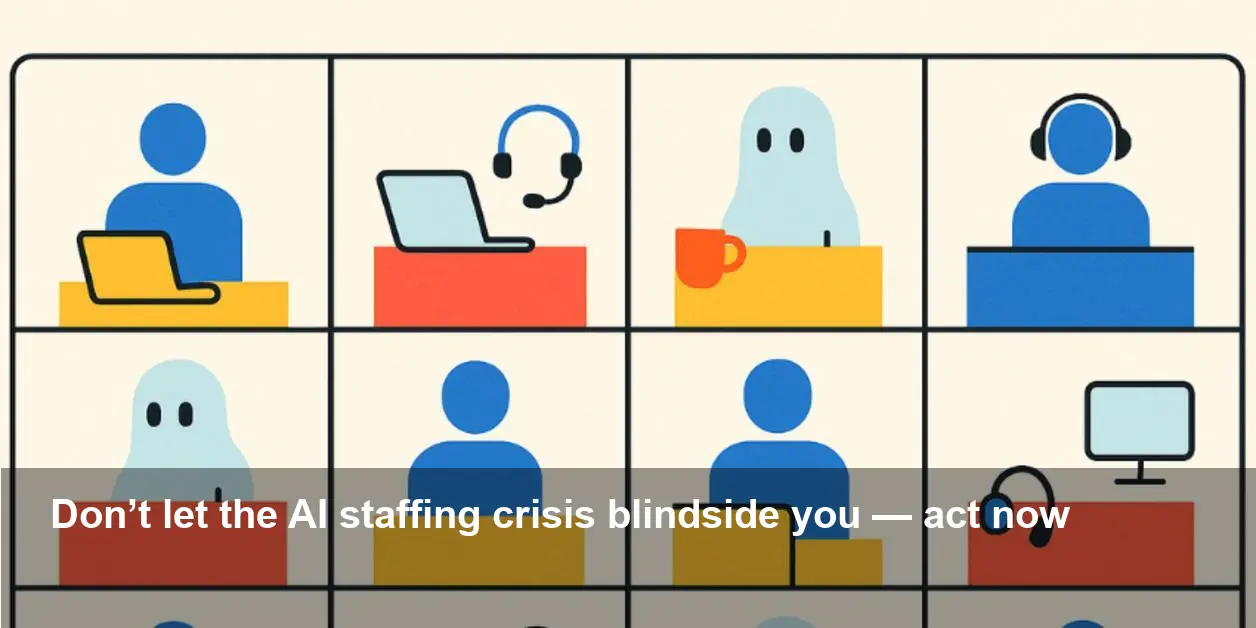
- Companies already using AI with humans are facing a quiet staffing crisis: workflows, schedules and KPIs aren’t built for blended teams.
- Lack of new roles, reskilling and governance is creating performance, compliance and morale risks across CX and operations.
- Immediate fixes: audit interactions, redesign schedules, create AI-ops roles, update SLAs and start rapid upskilling.
Human & AI Workforce Management: The New Staffing Crisis
The rollout of AI into frontline teams promised scale and efficiency. What many organizations didn’t anticipate is how quickly traditional workforce practices break down when humans and AI must work as a single system. The result: missed commitments, confused accountability and poorly utilized talent — a staffing crisis most leaders don’t yet recognize.
Why this is happening
AI changes the rules of capacity, attention and measurement. Traditional workforce management assumes uniform task times, predictable shrinkage and human-only performance metrics. When AI handles parts of interactions or generates variable outcomes, schedules, headcount models and KPIs become inaccurate.
Key drivers:
- Blended work fragmentation: Tasks split between human and AI increase handoffs and idle time.
- Skill mismatch: Agents need new skills (AI orchestration, prompt validation) that aren’t in job descriptions.
- Governance gaps: No clear policies for escalation, oversight or quality control of AI outputs.
- Metrics misalignment: Old KPIs (AHT, occupancy) don’t capture AI contribution or its failure modes.
Real risks to CX and the business
Unchecked, these gaps lead to slower response times, inconsistent customer experiences and higher rework. On the compliance side, unclear audit trails for AI decisions can expose firms to regulatory and reputational risk. Internally, employees feel undervalued or threatened when roles are ill-defined — driving turnover at the exact moment you need stability.
What leaders must do now
- Audit end-to-end workflows: Map where AI and humans interact. Identify handoffs, idle time and failure hotspots.
- Redesign scheduling and capacity models: Model blended-task time and build flexible staffing pools.
- Create new roles and ownership: Introduce AI-ops, AI-trainers, and AI escalation owners who control quality and governance.
- Update SLAs and KPIs: Add blended metrics — AI accuracy, human validation time, handoff rates, and customer-first outcome measures.
- Rapid reskilling and hiring: Train existing staff on AI oversight and prompt engineering; recruit for hybrid skill sets.
- Strengthen governance and auditability: Enforce logging, explainability checks and compliance reviews for AI outputs.
Operational tips for quick wins
- Run short pilot sprints to test new staffing mixes before full rollout.
- Use simulation tools to forecast blended capacity under different AI accuracy scenarios.
- Embed feedback loops so agents can flag AI failure patterns and gaps in training data.
Longer-term cultural shifts
Solve the crisis not just with tech, but with people-first change management. Communicate role evolution clearly, celebrate hybrid skills, and ensure leaders model collaboration between human teams and AI partners.
The blended workforce is not an inevitability to be feared — but it demands immediate attention. Companies that act now to redesign workforce management for human+AI teams will gain a performance edge; those that delay risk service degradation, regulatory exposure and talent loss.
Image Referance: https://www.cxtoday.com/ai-automation-in-cx/human-ai-workforce-management/