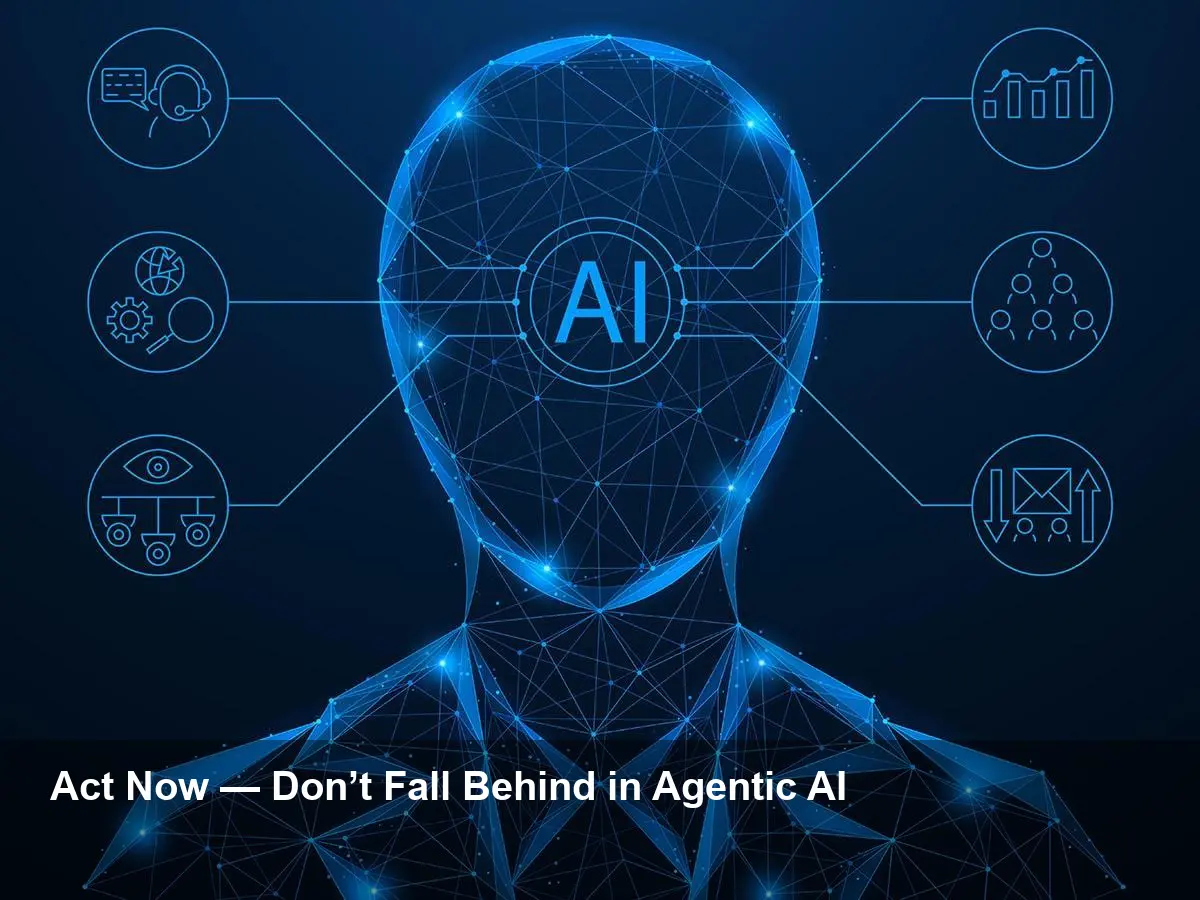
Beyond Automation: 2025 Made Enterprises Take Agentic AI Seriously
- Agentic AI moved from limited pilots to full enterprise operations across industries in 2025.
- Enterprises report faster, more proactive workflows and measurable efficiency gains — but governance and safety concerns rose alongside adoption.
- Adoption accelerated via orchestration platforms, human-in-the-loop design and focused upskilling programs.
- Companies now face a strategic choice: accelerate deployment with controls — or risk falling behind competitors.
Why 2025 Was a Turning Point
The last year marked a distinct shift in how firms use artificial intelligence. Agentic AI — systems that can act autonomously to complete tasks, make decisions, and coordinate across tools — graduated from experimental pilots into core enterprise operations. Rather than only automating repetitive tasks, these agents began to orchestrate cross-team processes, surface decisions proactively, and reduce the latency between insight and action.
From Pilots to Production
Enterprises moved beyond proof-of-concept projects by integrating agentic agents into customer support, IT operations, procurement and risk monitoring. The focus changed from “Can this work?” to “How fast and safely can we scale?” That mindset forced CIOs and business leaders to prioritize orchestration frameworks, centralized monitoring, and explicit escalation paths when agents operate autonomously.
Operational Gains — and New Responsibilities
Companies that committed to agentic AI report notable improvements in speed and proactivity: agents catching anomalies earlier, triaging incidents, and initiating remedial actions without waiting for human prompts. This created measurable productivity effects and a clearer ROI calculus that persuaded more conservative stakeholders to greenlight deployments.
Governance, Safety and Human Oversight
With greater agency comes greater risk. Organizations that rushed deployments without robust guardrails faced issues from incorrect automated actions to compliance gaps. As a result, the most successful adopters emphasized a layered approach: human-in-the-loop checkpoints for high-risk decisions, continuous auditing of agent behavior, and role-based permissions that limit what agents can change.
Platforms, Standards and Upskilling
Tooling matured rapidly in 2025. Orchestration platforms that coordinate multiple agentic components, provide audit trails and surface explainability became de facto infrastructure. Equally important, firms invested in upskilling programs so staff could design, supervise and intervene when agents acted unexpectedly — shifting roles from task doers to system stewards.
The Strategic Imperative
What began as automation is evolving into a new operating model: proactive, agent-driven workflows woven into enterprise processes. For organizations deciding their next steps, the trade-off is clear — move deliberately but quickly. Those that delay risk operational lag and competitive disadvantage; those that move too fast without governance invite operational and reputational harm.
In short, 2025 didn’t just accelerate agentic AI’s technical capabilities — it forced a business reckoning. Successful programs blend aggressive experimentation with disciplined governance, clear metrics for impact and a plan for workforce transition. The companies that balance speed, safety and skills will set the new standard for enterprise operations in the years ahead.
Image Referance: https://www.forbesindia.com/amp/article/ai-tracker/beyond-automation-how-2025-made-enterprises-take-agentic-ai-seriously/2990249/1