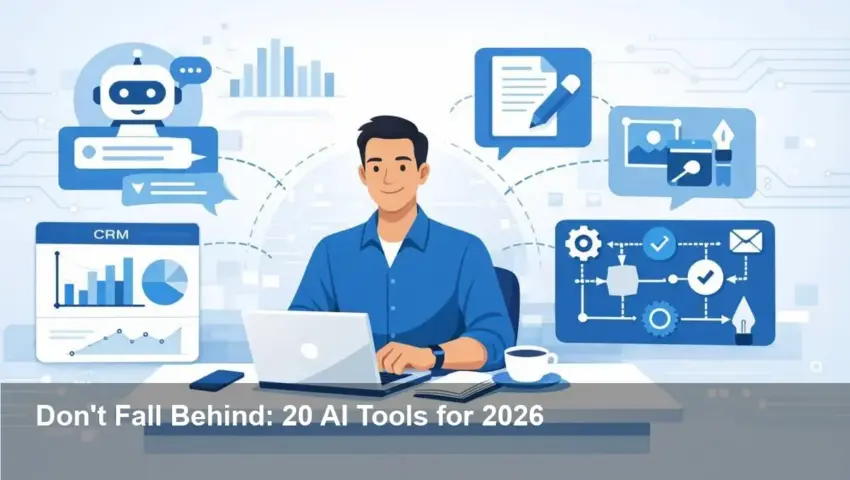
- 20 best AI tools for small businesses compiled and verified for 2026.
- Coverage spans CRM, marketing, customer support, accounting and automation with free and paid options.
- Recommendations highlight risk of falling behind, proven ROI examples and verified pricing where available.
- Practical selection tips to pick tools that reduce cost and scale operations quickly.
Overview: Why these AI tools matter in 2026
Small businesses face growing pressure to automate and personalize or risk losing customers to faster rivals. This curated list of 20 AI tools focuses on practical, revenue-oriented solutions — CRM, marketing, support, accounting and workflow automation — and compares free and paid tiers so owners can act now with confidence.
What the list covers
- CRM & sales automation: tools that improve lead capture and pipeline management.
- Marketing & content: AI for copy, design, and campaign optimization.
- Customer support: chatbots, ticketing and AI-assisted responses.
- Finance & operations: bookkeeping, invoicing and forecasting automation.
- Workflow automation: integrations that connect apps and remove manual tasks.
Sample picks and why they matter
The full 20-tool roundup includes both established platforms and rapid newcomers. A few representative picks from the list:
- AI CRM (e.g., HubSpot / Zoho AI): Uses automated lead scoring and email sequences to boost conversions — free tiers available, paid plans scale with features.
- Marketing & copy (e.g., ChatGPT, Jasper, Copy.ai): Generate landing pages, ads and product descriptions faster; reduces agency costs and shortens campaign cycles.
- Design & creative (e.g., Canva’s AI tools): Templates and generative assets let small teams produce polished visuals without hiring designers.
- Support & chatbots (e.g., Intercom, Freshdesk AI): Provide 24/7 responses and reduce first-response times dramatically — critical to customer retention.
- Automation (e.g., Zapier, Make): Connect apps and automate repetitive tasks; often the quickest route to measurable time savings.
- Accounting automation (e.g., QuickBooks with AI features): Automates invoicing, expense categorization and basic forecasting to reduce bookkeeping overhead.
How to choose the right tools for your business
1) Start with the problem: prioritize tools that solve your highest-cost tasks (customer churn, slow lead follow-up, manual invoicing). 2) Test free tiers or short trials before committing; most tools offer scaled pricing. 3) Check integrations — pick tools that fit your current stack to avoid rework. 4) Measure impact: track time saved, conversion lift or cost reductions in the first 30–90 days.
Bottom line
The 20 AI tools compiled for 2026 are practical, vetted options designed to help small businesses get measurable results quickly. Failing to adopt appropriate AI now isn’t just a missed opportunity — it’s a competitive risk. Evaluate by impact, start small, and scale what demonstrably improves revenue or efficiency.
Image Referance: https://www.how2shout.com/tools/best-ai-tools-small-businesses.html