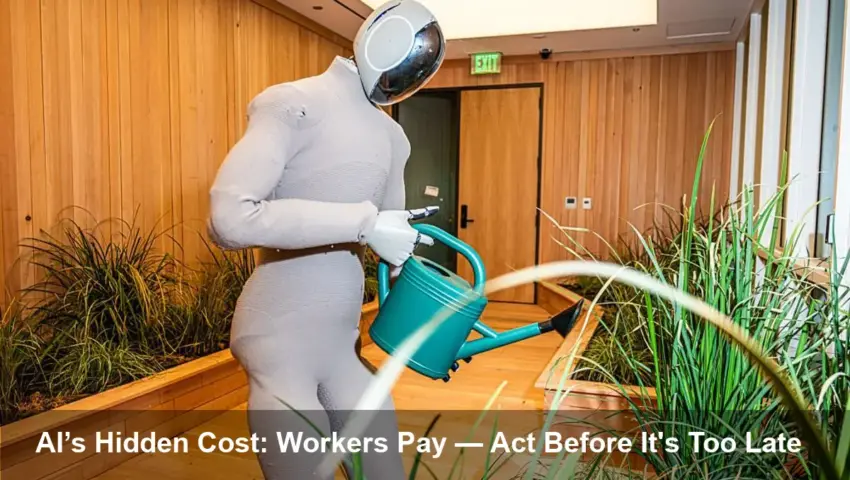
- AI depends on human labor for data, maintenance, and oversight despite claims of autonomy.
- Automation risks deskilling workers, increasing surveillance, and concentrating power in platforms and corporations.
- Whether AI liberates or impoverishes workers will hinge on who governs its design, deployment and profit.
The Sorcerer’s Apprentice Problem: AI, Labor and Control
AI is often portrayed as an inexorable force — a takeover by code and models that will replace human labor. But beneath the hype lies a simpler truth: contemporary AI systems are still deeply dependent on human labor to be built, tuned, deployed and supervised. That dependence creates what critics call a modern Sorcerer’s apprentice problem: creators unleash systems they cannot fully control, while workers pay the social and economic costs.
Human labor behind machine intelligence
From data labeling and content moderation to prompt engineering and system monitoring, AI requires a broad ecosystem of human tasks. Companies rely on low-paid annotators to clean and tag training data, employed moderators to police outputs, and engineers and technicians to integrate models into platforms. Even “autonomous” systems are audited, corrected and propped up by human labor — often precarious, outsourced, or invisible.
Deskilling, surveillance and managerial power
Automation can promise efficiency, but evidence shows a different pattern: managerial control increases even as formal skill requirements shift. Tasks are broken into narrower steps; workers do simpler, repetitive actions that train models and erode craft. At the same time, AI tools become instruments of surveillance and performance monitoring, allowing employers to measure and micromanage at scale. The result is not universal liberation but new forms of extraction and vulnerability.
Who benefits?
The gains from AI have largely accrued to technology firms, platform owners and corporate managers who control data and deployment. Without democratic governance or strong labor institutions, the bargaining power of workers weakens — while intellectual property and productization concentrate profits in a few hands. That trajectory confirms, rather than challenges, existing economic inequalities.
Policy and collective responses
Addressing the Sorcerer’s apprentice problem requires shifting the terrain of control. Possible remedies include stronger labor protections for gig and platform workers, collective bargaining over AI deployment, public investment in open models, transparency mandates for automated decision-making, and regulatory limits on surveillance practices. Crucially, workers and communities must have a seat at the table where AI systems are designed and governed.
Act now or watch the gap widen
The stakes are urgent. If AI development continues under current incentives, we are likely to see greater deskilling, more surveillance, and increasing inequality. But because these technologies depend on human labor, they are also contestable: public policy, unions and social movements can shape whether AI becomes a liberating force or a mechanism of control. The Sorcerer’s apprentice problem is not a mystery to be solved by engineers alone — it is a political question about power, ownership and who decides the future of work.
Image Referance: https://jacobin.com/2026/01/ai-automation-deskilling-worker-control