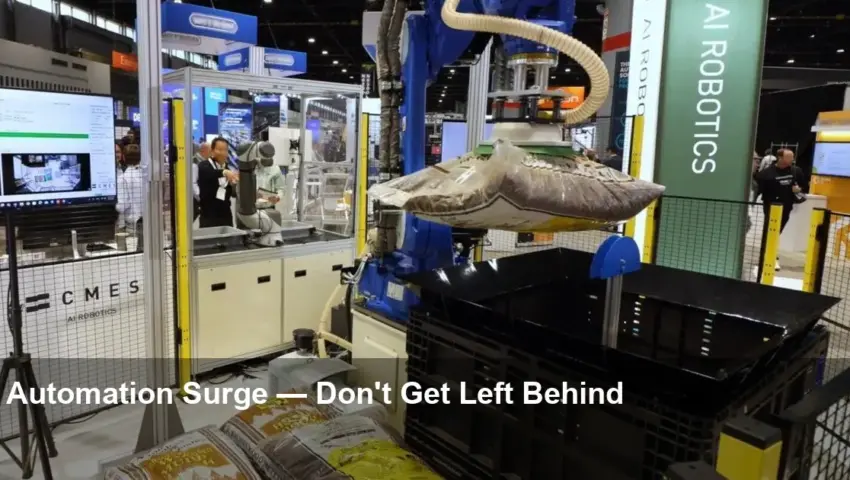
- CMES Robotics has expanded its AI-driven warehouse automation footprint with new logistics projects.
- The company is addressing palletizing and depalletizing challenges across eCommerce, logistics, food & beverage, and manufacturing.
- AI-enabled systems promise faster, more consistent pallet handling but raise integration and workforce questions.
What happened
CMES Robotics has expanded its AI-driven warehouse automation footprint with a series of new logistics projects aimed at solving persistent palletizing and depalletizing problems. The work focuses on automating repetitive, error-prone tasks across eCommerce, logistics, food & beverage, and manufacturing operations.
Why this matters
Automation of palletizing and depalletizing addresses bottlenecks that slow order fulfillment and increase costs. By combining robotics with vision systems and AI controls, companies can handle varied products, fragile items, and mixed pallets with greater speed and reliability than traditional manual methods. For retailers and logistics providers under margin pressure, these gains translate directly to lower labor costs, fewer damaged goods and faster turnaround.
How companies are solving the problem
Innovative firms are pairing flexible robotic arms with AI vision and software orchestration to identify SKU variety, orientation and weight distribution. That lets robots choose gripping strategies and stacking patterns on the fly, reducing jams and mis-stacks that commonly occur in high-throughput warehouses. Integrations with warehouse management systems (WMS) and conveyor networks are central, allowing automated cells to fit into existing operations rather than forcing full-line rebuilds.
What to watch for
Operational gains and risks
The upside is clear: improved throughput, repeatability, and safety. But the rollout of AI-driven palletizing is not without challenges. Implementation requires careful calibration, change management and data integration. If projects are rushed, companies risk costly downtime or systems that underperform under real-world variability.
Workforce impact
Automation creates uncertainty for frontline workers. While some roles shift toward system supervision, maintenance and programming, others may be reduced. Companies that pair deployment with retraining initiatives tend to mitigate disruption and retain institutional knowledge.
Industry reaction and next steps
Leading operators across eCommerce, logistics, food & beverage and manufacturing are increasingly testing and adopting robotic palletizing solutions. For businesses evaluating automation, the next steps are mapping current throughput pain points, piloting small-scale cells that integrate with WMS, and measuring uptime and error rates before scaling.
Quick takeaway
CMES Robotics’ expansion highlights a clear trend: AI-driven palletizing and depalletizing are moving from niche experiments to practical logistics solutions. Companies that move carefully and prioritize integration and workforce transition stand to gain the most—those that delay risk falling behind in speed, cost and reliability.
Image Referance: https://www.gjsentinel.com/online_features/press_releases/cmes-robotics-expands-ai-driven-warehouse-automation-footprint-with-new-logistics-projects/article_392d52d5-2402-505d-ae05-368855ec3336.amp.html