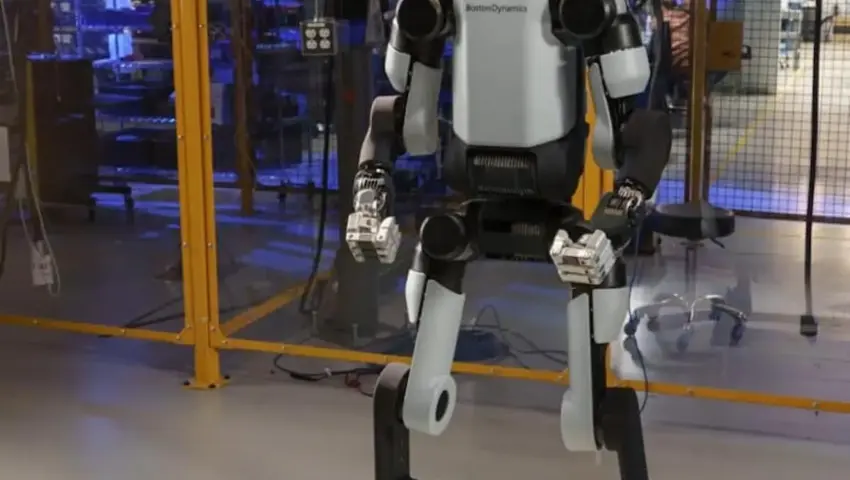
- Boston Dynamics and Google DeepMind announced a new AI partnership to integrate Gemini Robotics foundation models with the Atlas humanoid robot.
- The collaboration aims to expand Atlas’s industrial capabilities, combining advanced AI with proven hardware.
- The move could accelerate deployment of humanoid robots in manufacturing, logistics and hazardous-work environments — but it raises safety and workforce questions.
What happened
Boston Dynamics and Google DeepMind have formed a strategic AI partnership to integrate DeepMind’s Gemini Robotics foundation models with Boston Dynamics’ Atlas humanoid robot. The teams say the goal is to give Atlas more general-purpose intelligence for industrial tasks, building on Boston Dynamics’ hardware and DeepMind’s advances in large-scale robotics models.
Why this matters
The collaboration pairs one of the industry’s most capable humanoid platforms with a family of foundation models designed for robots. In practical terms, that could shorten the time it takes for Atlas to learn new tasks, adapt to varied environments and coordinate complex sequences of motion without task-by-task engineering.
Potential near-term applications include warehouse sorting, light assembly, inspection in confined or dangerous spaces, and repetitive tasks where human presence is costly or risky. Because foundation models are trained to generalize, Atlas could move beyond scripted behaviors toward more flexible, perceptive operation.
Possible benefits and industry impact
- Faster rollout: Pretrained robotics models could let manufacturers prototype and scale humanoid deployments more quickly.
- Broader competence: Foundation models aim to transfer learning across tasks, meaning Atlas may handle varied job types with fewer custom solutions.
- Competitive pressure: Other robotics firms and integrators may accelerate their own AI efforts to keep pace, increasing industry momentum.
Risks, safety and social questions
The partnership also highlights important challenges. Humanoid robots with more autonomous decision-making raise safety, oversight and regulatory questions. Ensuring predictable behavior in dynamic industrial environments requires rigorous testing, formal safety measures and clear human-in-the-loop controls.
There are workforce concerns as well: making humanoids more capable could change labor needs in logistics and manufacturing. Companies and policymakers will need to balance productivity gains with retraining, transition strategies and transparent deployment plans.
What to watch next
Both firms have a history of deliberate, research-driven development. Observers should look for demonstrations, developer tools, safety frameworks and pilot programs that show how Gemini Robotics models are applied to Atlas hardware. Any public pilots, safety reports or open technical papers will offer the clearest evidence of how far and how fast capabilities expand.
The announcement signals a clearer path toward industrial-grade humanoids that combine strong mechanical design with advanced AI. That mix promises faster innovation — and renewed debate over how to deploy humanoid robots responsibly and safely.
Image Referance: https://roboticsandautomationnews.com/2026/01/25/boston-dynamics-and-google-deepmind-announce-ai-partnership-focused-on-humanoid-robots/98270/