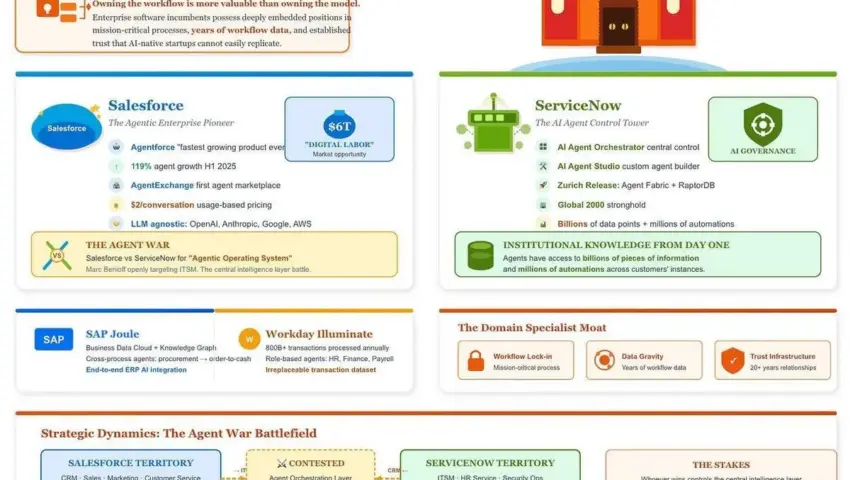
• Domain specialists prioritize owning workflows over building models, creating durable enterprise advantages.
• Incumbent vendors hold years of workflow data and trusted relationships that AI-native startups struggle to match.
• What they sell: agentic workflow platforms, governance, orchestration and enterprise operating layers.
• The real moat is workflow lock-in plus customer switching costs — not just a better model.
What the Domain Thesis Says
The domain thesis flips a common assumption about AI: owning the model is not the same as owning the business. For so-called Domain Specialists, the asset that matters is the workflow — the sequence of actions, integrations and approvals that run mission-critical processes inside enterprises. These incumbents don’t just provide tools; they sit inside operational routines and collect years of contextual workflow data and trust relationships that are hard to recreate.
Why workflows create durable moats
Workflows bundle multiple advantages. First, they generate longitudinal data tied to real business outcomes — not isolated model prompts — which improves automation accuracy over time. Second, workflows embed governance and compliance controls that enterprises require. Third, because workflows connect to many systems and people, they produce high switching costs: replacing a workflow often means rethinking processes, retraining staff and rebuilding integrations.
What Domain Specialists sell
Rather than selling standalone models, Domain Specialists position products as platforms for agentic workflows, governance, orchestration and enterprise operating layers. These offerings coordinate tasks across systems, enforce policy and provide audit trails — functions enterprises value above raw model performance. The result is a product that becomes part of a company’s operating fabric, not an optional add-on.
Why AI-native startups struggle to replicate this
AI-first startups often excel at model innovation or narrow point solutions, but they lack the embedded presence in mission-critical processes. They typically don’t have years of workflow history or the same depth of integration and trust inside enterprises. That makes it difficult for them to displace incumbents who already control orchestration, governance and the human processes that surround automation.
Implications for product and go‑to‑market strategy
For vendors and builders, the lesson is practical: prioritize owning and improving workflows, not simply surfacing a stronger model. That means investing in integrations, auditability, role-based controls, and measurable outcome tracking. For enterprises evaluating vendors, the strategic question is whether a provider is offering a replaceable model or a durable operating layer tied to your processes.
Bottom line
The competitive advantage in enterprise automation often lives in the workflow, not the algorithm. Domain Specialists turn process ownership into a fortress: years of data, embedded trust and governance mechanisms that create workflow lock-in and raise the bar for newcomers.
Image Referance: https://fourweekmba.com/archetype-4-domain-specialists-the-workflow-fortresses/