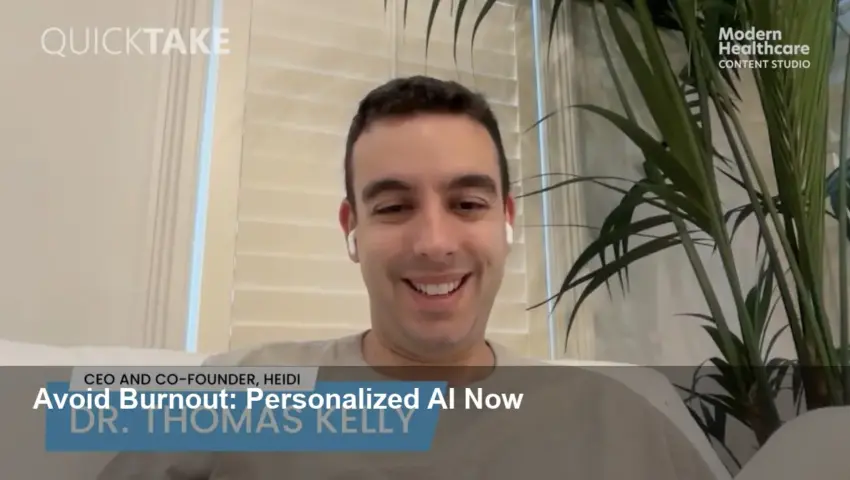
- Heidi Health CEO Tom Kelly argues flexible AI can reduce clinician burnout and improve documentation.
- AI tools that adapt to workflows can support health systems at scale without forcing major EHR changes.
- Successful adoption requires clinician trust, tight integration, and attention to privacy and accuracy.
What Tom Kelly says about AI in healthcare
Heidi Health CEO Tom Kelly discusses how modern AI tools, when designed to be flexible and personalized, can tackle three persistent problems in healthcare: clinician burnout, time-consuming documentation, and the challenge of scaling support across large health systems. Kelly frames AI not as a replacement for clinicians but as a tool to streamline routine work and restore time for patient care.
Why flexibility and personalization matter
Many AI pilots fail because solutions are rigid or require clinicians to change established workflows. Kelly emphasizes that AI must adapt to real clinical processes — learning from individual clinician habits, specialty needs and institutional protocols — rather than forcing staff into a narrow, one-size-fits-all approach.
Personalized AI can surface the most relevant information, reduce repetitive documentation tasks and shorten administrative workflows. That makes the technology more likely to be accepted by clinicians and useful at the point of care.
Potential benefits: burnout, documentation and scale
The three headline benefits Kelly highlights are straightforward:
- Reduced clinician burnout: By automating repetitive administrative tasks and simplifying documentation, AI can free clinicians to focus on patient interaction and decision-making.
- Improved documentation: AI-assisted notes, summaries and coding support can make clinical records more complete and consistent while reducing time spent typing.
- Support at scale: Flexible AI platforms can be deployed across different departments and facilities, enabling large health systems to get consistent benefits without bespoke development for every site.
These benefits are framed as practical outcomes rather than promises — the gains depend heavily on implementation quality and ongoing clinician engagement.
Barriers and what systems must address
Kelly also underscores that technology alone won’t solve these problems. Health systems must address:
- Integration with EHRs and existing tools so AI fits into daily workflows.
- Clinician trust through transparent models, explainability and clinician control over AI output.
- Data privacy and compliance to protect patient information and meet regulatory requirements.
- Continuous monitoring to catch errors, bias or drift in models as clinical practice changes.
Why this matters now
As staffing pressures and documentation demands remain high, systems that experiment with flexible, clinician-centered AI may gain a meaningful edge in workforce sustainability and efficiency. But the path to impact is cautious: pilot thoughtfully, involve clinicians early, and measure real-world outcomes rather than vendor claims.
Heidi Health’s perspective — as explained by Tom Kelly — is a reminder that AI’s promise in healthcare depends less on flashy algorithms and more on practical design choices that respect clinical workflows, clinician time and patient safety.
Image Referance: https://www.modernhealthcare.com/videos/quicktake/mh-making-ai-more-flexible-personalized-healthcare/