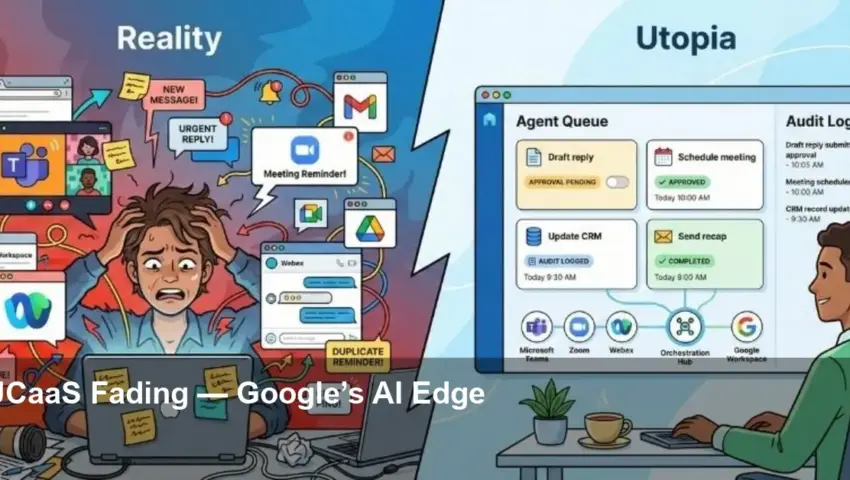
- UCaaS is turning into commodity infrastructure as agentic AI shifts value to an orchestration layer.
- Google’s Gemini gives it a viable path to dominate orchestration — but success depends on governance and enterprise data readiness.
- Winning requires plugging AI into existing comms stacks, strong APIs, and clear controls for privacy and compliance.
Why UCaaS alone won’t decide the next battle
Unified Communications as a Service (UCaaS) has become reliable, standardized infrastructure for voice, messaging and meetings. That stability reduces differentiation — price, uptime and integrations are table stakes — and leaves less room for platform vendors to capture long‑term value purely from comms features.
The value shift: agentic AI and the orchestration layer
Agentic AI — models that can carry out tasks, route workflows and act across systems — moves value away from basic UCaaS features toward an orchestration layer that coordinates AI agents, business workflows and communications channels. This layer sits above UCaaS providers and can unify data, automation and user experience across multiple services.
For enterprises this matters because orchestration is where contextual understanding, policy enforcement and cross‑system automation live. A well‑designed orchestration layer can generate continuous business value even if underlying UCaaS providers are interchangeable.
Where Google and Gemini fit in
Google’s Gemini gives it a credible AI stack to build an orchestration play. With a powerful model and an ecosystem of cloud services, Google could provide the connective tissue that turns raw LLM capabilities into task‑oriented agents that integrate with UCaaS platforms. The key advantage is reach: orchestration depends on integrating diverse systems, and Google’s cloud footprint and developer tools can accelerate that work.
What Google must get right
- Data readiness: Enterprises need clean, accessible datasets and integration hooks so AI agents can act on accurate context. Without data engineering and APIs, powerful models won’t produce reliable outcomes.
- Governance and controls: The orchestration layer must enforce privacy, auditability and compliance. Enterprises will favor solutions that make policy enforcement transparent and manageable.
- Extensibility and open integration: Success requires easy connectors to multiple UCaaS vendors and business systems so customers aren’t locked in to a single comms supplier.
Why this matters for enterprises and vendors
Enterprises should watch orchestration strategies closely: choosing a vendor for orchestration affects data flows, compliance posture and the future cost of automation. UCaaS vendors risk commoditization if they don’t partner with or build orchestration capabilities that embed AI safely and usefully.
Bottom line
Google may not have “won” the UCaaS platform battle, but it still has a path to shape the next layer of enterprise communications through AI orchestration. The deciding factors won’t be models alone — they’ll be governance, data readiness and the ability to integrate seamlessly into established comms ecosystems. Organizations that plan for those needs now will avoid costly rework and gain a strategic edge as agentic AI reshapes workplace communications.
Image Referance: https://www.uctoday.com/unified-communications/google-didnt-win-ucaas-but-it-could-still-win-the-ai-orchestration-layer/