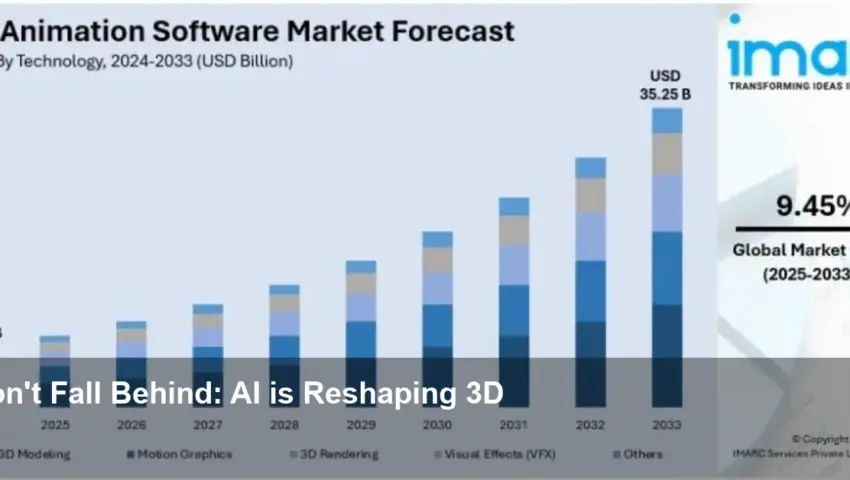
- IMARC Group press release identifies gaming demand and AI automation as primary growth drivers for the 3D animation software market.
- Real-time game engines and cross-industry adoption are increasing demand for 3D assets and tools.
- AI-powered automation is speeding up rigging, animation and texturing workflows, lowering costs and timelines.
- Studios that don’t adapt risk falling behind competitors harnessing these tools.
What the press release says
IMARC Group, a market research firm, issued a press release highlighting gaming and AI automation as key forces expanding the 3D animation software market. The announcement frames this as a structural shift: demand for real-time 3D content from games and related industries plus faster, automated production tools are changing how 3D work is created and consumed.
Why gaming is a growth engine
Game development has long driven investment in 3D tools. Today, several trends within gaming are amplifying that effect: the rise of real-time rendering workflows, broader use of game engines beyond traditional games (virtual production, XR, interactive experiences), and the acceleration of mobile and indie game markets that require large volumes of 3D assets. These needs push studios and tool vendors to prioritize speed, interoperability and real-time previewing — features that increase software adoption across the creative pipeline.
How AI automation is changing workflows
AI automation touches multiple stages of 3D production. Generative tools and machine learning are being used for procedural asset creation, automated rigging and skinning, motion in‑betweening, texture and material generation, and cleanup of motion‑capture data. By automating repetitive or technical steps, these tools reduce turnaround times and let artists focus on creative decision‑making rather than manual drudgery.
Implications for studios and creators
As IMARC notes, the combined effect of gaming demand and AI-driven tooling lowers barriers to entry and enables smaller teams to produce content that previously required much larger resources. That creates both opportunity and risk: teams that adopt new workflows can scale faster and compete on complexity and iteration speed; teams that resist change may lose bids or miss pipeline efficiencies.
Challenges and cautions
Automation brings tradeoffs. Studios must manage quality control, ensure artistic direction remains central, and address ethical questions around synthetic content and data usage. Integration with existing pipelines can be complex, and there is a learning curve for artists adapting to AI‑augmented tools. IMARC’s framing signals that these are important considerations even as the market expands.
Bottom line
The press release from IMARC Group points to gaming’s insatiable need for real‑time 3D assets and the productivity gains from AI automation as twin drivers reshaping the 3D animation software market. For studios, game developers and toolmakers, the message is clear: adopt the new toolsets and workflows or risk being outpaced by competitors who do.
Image Referance: https://www.openpr.com/news/4364463/how-are-gaming-and-ai-automation-driving-growth-in-the-3d