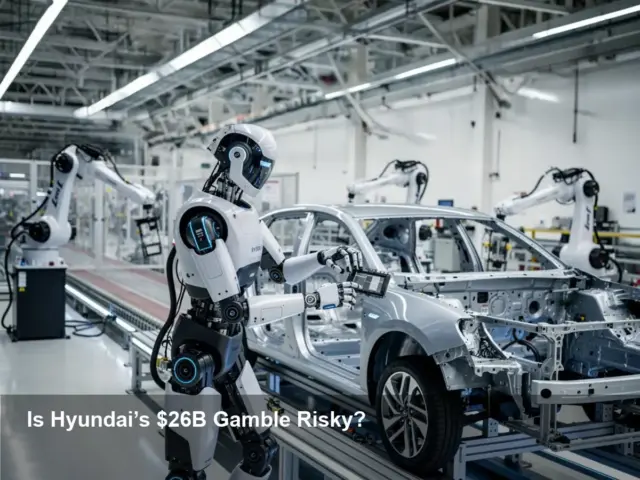
- Hyundai is directing a $26 billion expansion in the U.S. focused on EVs, steel production and robotics.
- The strategy signals a move toward vertically integrated manufacturing and advanced automation.
- The push could accelerate EV output and automation but brings commercial and operational risks.
What Hyundai’s $26B expansion covers
Hyundai’s $26 billion U.S. expansion centers on three connected areas: electric vehicles (EVs), domestic steel production, and robotics. The package described in the short summary positions the company to scale EV manufacturing while investing in the supply chain and factory automation that support higher output.
This combination — vehicle production, upstream materials and robots on the assembly line — points to a strategy of closer integration across the manufacturing process rather than relying solely on external suppliers.
Why this move matters
The mix of EVs, steel and robotics matters for several reasons. First, increased EV capacity in the U.S. would let Hyundai respond more quickly to local demand and policy incentives that favor domestic production. Second, boosting steel production domestically can shorten supply chains and reduce exposure to overseas bottlenecks. Third, heavier use of robotics signals a broader shift toward automated, higher‑throughput factories that can lower unit costs and raise consistency.
Taken together, the expansion is more than a capacity play — it’s an attempt to reshape how Hyundai builds cars and components in the U.S., and to prepare the company for a faster transition to electric mobility.
Risks, tradeoffs and the “robot revolution”
The plan is bold but not without risks. A large capital outlay concentrated on new factories, steel capacity and automation tools increases exposure to changes in demand, EV market cycles, and technological uncertainty. Heavy automation can boost productivity, but it also shifts the mix of required skills and complicates labor relations and retraining plans.
The phrase “robot revolution” captures both opportunity and unease: more robots could mean faster, cheaper production — and fewer traditional assembly‑line roles or different job requirements for workers. For communities and policymakers, that tension is a central consideration.
What to watch next
Key things to watch going forward include any details on timelines, factory locations, how much of the investment is dedicated to steel versus vehicle assembly or robotics, and whether Hyundai outlines workforce transition plans. The practical outcomes — increased EV volumes, shorter supply chains, and greater automation — will determine whether the $26 billion bet delivers long‑term advantage or becomes a costly gamble.
For readers tracking the auto industry, Hyundai’s move is a clear signal that OEMs are rethinking where and how cars are made. Whether this investment becomes a model other automakers follow will hinge on execution and market response.
Image Referance: https://www.abacusnews.com/the-26b-gamble-how-hyundais-u-s-bet-and-robot-revolution-could-redefine-an-auto-giant/