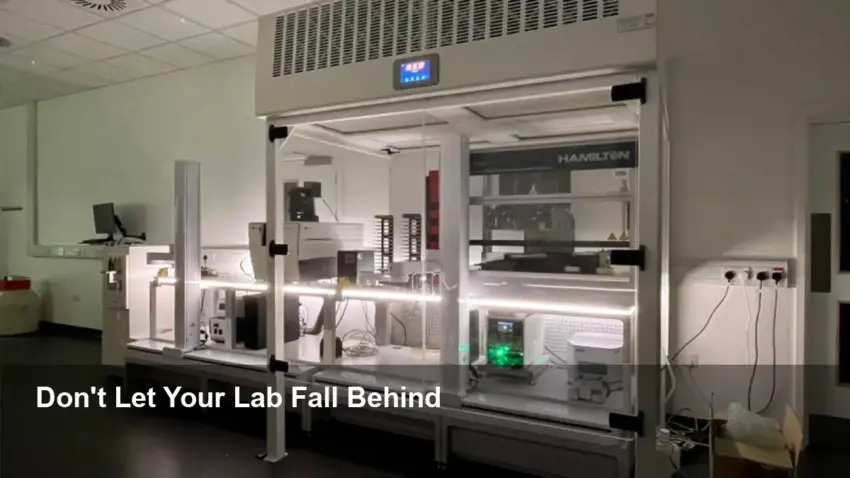
- Beckman Coulter Life Sciences has partnered with Automata to integrate laboratory instruments with an AI-ready automation platform.
- The collaboration aims to accelerate research workflows, enable scalable experimentation and improve reproducibility.
- Labs that adopt integrated, AI-ready automation are likely to scale faster; those that don’t risk operational bottlenecks and slower discovery.
What happened
Beckman Coulter Life Sciences announced a partnership with Automata to combine its lab technologies with Automata’s AI-ready automation platform. The collaboration is positioned to connect instruments, workflows and data platforms so that routine lab tasks, experiment orchestration and data capture work together more seamlessly.
The companies say the integration will focus on making laboratory operations more automation-friendly and machine-readable, which supports higher-throughput experimentation and prepares datasets for downstream AI analysis. While details on specific product integrations or deployment timelines were not provided in the announcement, the stated goal is clear: reduce manual intervention and scale experiments reliably.
Why this matters
Integrated automation is becoming a baseline expectation in modern life-science research. When instruments and software are connected into a coherent automation platform, labs can run more experiments, shorten iteration cycles and improve reproducibility. For organizations racing to discover new drugs, diagnostics or biologics, those speed and scale advantages translate directly into competitive value.
There is also a data angle: AI and machine learning perform best on consistent, well-structured datasets. By making data capture part of an automation-first workflow, the partnership aims to produce cleaner, standardized outputs that are easier to use for modelling and decision-making.
Impact for different labs
Academic and core facilities
Core facilities and academic labs that adopt integrated automation can offer more reliable services to researchers and increase throughput without proportionally increasing staff time. That can free scientists to focus on experimental design and analysis rather than manual sample handling.
Biotech and pharmaceutical companies
For commercial labs, scaling experiments reliably is essential to accelerate development pipelines. Automation that’s AI-ready can help teams optimize protocols faster and reduce costly human error.
What to watch next
Expect the partnership to produce joint integration workflows, reference configurations and possibly certification or support programs so customers can deploy combined solutions more easily. Users will be watching for practical details: which instruments are supported, how data is exported, deployment models and any prebuilt connectors to popular lab informatics systems.
Bottom line
The Beckman Coulter–Automata tie-up signals a continued push toward automation that not only runs lab hardware but also prepares data and workflows for AI. Labs that embrace these integrated platforms may gain speed, reproducibility and scale — while those that delay risk falling behind in an increasingly automation-driven research environment.
Image Referance: https://roboticsandautomationnews.com/2026/02/04/beckman-coulter-life-sciences-partners-with-automata-to-accelerate-ai-ready-laboratory-automation/98601/