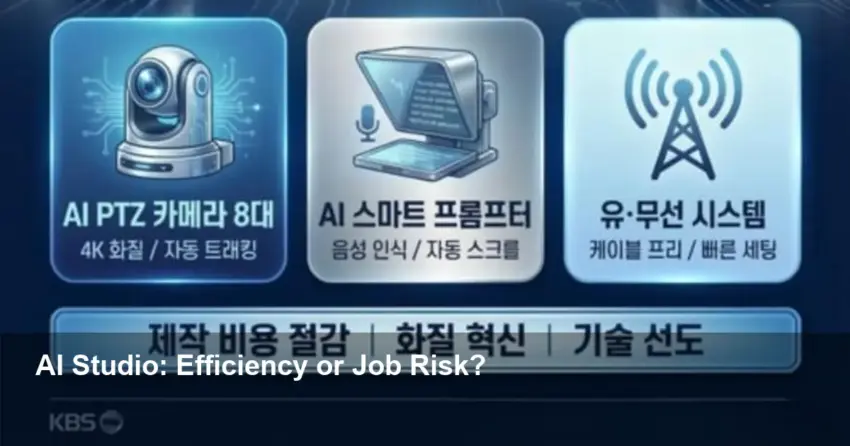
- KBS has introduced an AI-driven TV studio that pairs PTZ cameras with automated production tools.
- The setup aims to speed workflows and reduce manual camera and switching tasks.
- Broad adoption could reshape newsroom and studio staffing, and raise editorial and ethics concerns.
What KBS announced
KBS has rolled out an AI TV studio that combines pan-tilt-zoom (PTZ) camera systems with automation driven by artificial intelligence. The broadcaster says the integration is intended to streamline routine production tasks — camera framing, tracking, basic switching and metadata handling — so staff can focus on higher‑value editorial work and creative decisions.
How the system works
The core components are PTZ cameras that can be controlled remotely and AI software that automates camera moves, shot selection and some aspects of live switching. By using computer vision and rules-based decision logic, the studio can detect speakers, follow action across a set and apply repeatable shot patterns without a human operator on every camera.
This kind of setup typically links camera control with production management systems, making it easier to store metadata, cue clips and speed up post‑production because shots and timestamps are captured more consistently.
Why this matters
The practical upside is faster, more consistent live production at lower marginal cost per show. For KBS, the move signals a step toward modernizing broadcast workflows and scaling output across more channels or formats without expanding floor staff proportionally.
There is also a strategic angle: adopting AI systems now positions KBS to experiment with new program formats, remote production and hybrid live/recorded workflows that rely on automation to manage complexity.
Concerns and industry implications
Automation in studios prompts predictable concerns. One is workforce impact: fewer hands-on roles for camera operators or switchers if systems prove reliable. Another is editorial and quality control. Automated systems can handle routine tasks well, but judgment calls — camera framing for sensitive interviews, aesthetic choices and on‑the‑fly editorial decisions — still rely on experienced humans.
There are also ethical and safety questions around AI in broadcasting: accuracy of automated captions, correct identification of speakers, and safeguarding against manipulated or synthetic imagery. Broadcasters must define clear oversight, rollback procedures and transparency for audiences when AI is used.
What to watch next
Expect KBS to pilot the system across specific shows before broader rollout. Industry observers will watch for how the balance between automation and human control evolves, whether new roles emerge (AI operators, metadata editors) and how unions and staff respond.
If successful, the move could accelerate similar deployments at other broadcasters exploring cost savings and workflow gains. But widespread adoption will depend on proving reliability, maintaining creative standards and setting policies that address staffing and ethical risks.
Bottom line
KBS’s AI TV studio marks a clear push toward automated production. It promises efficiency and scalability, but also raises questions about jobs, quality and governance — issues the broadcaster and the wider industry now need to resolve.
Image Referance: https://www.chosun.com/english/kpop-culture-en/2026/02/05/AFN3TZRWJ5CWNLHC7NZ7AUWKJI/