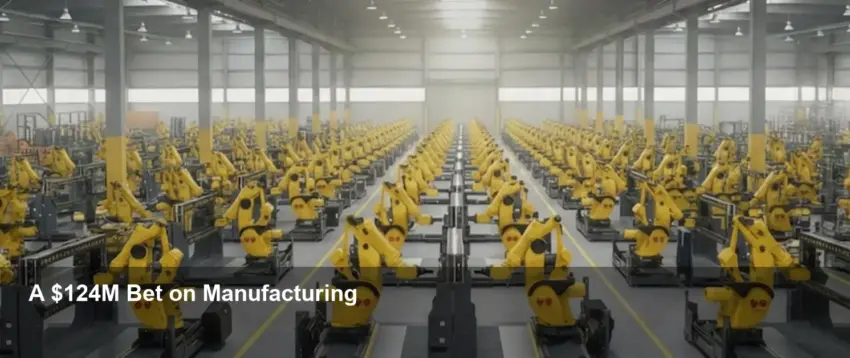
- Machina Labs has raised $124 million to launch a large-scale intelligent factory.
- Funding will be used to scale AI-driven manufacturing for defense, aerospace and advanced mobility.
- The move highlights growing investor interest in automated, software-led industrial production.
What happened
Machina Labs announced a $124 million funding raise to support the launch of a large-scale intelligent factory. The company says the new facility will scale AI-driven manufacturing capabilities aimed at sectors with demanding performance and quality requirements: defense, aerospace and advanced mobility.
Why this matters
This is a clear signal that investors are backing a shift from small, specialized robotic cell installations to broader, software-defined manufacturing infrastructure. For industries like defense and aerospace — where precision, traceability and repeatability are critical — intelligent factories promise faster throughput and tighter integration between design, production and verification.
The announcement taps into several current trends: growing demand for onshore, resilient manufacturing; increased use of machine learning and computer vision in production; and a push to shorten development cycles for advanced mobility platforms. For suppliers, OEMs and systems integrators, the raise is both an opportunity and a warning: the competitive landscape is changing, and organizations that don’t adapt may fall behind.
Potential impact across sectors
Defense
AI-enabled manufacturing can improve part consistency and inspection, which matters for safety-critical systems. Greater automation could also change procurement and qualification processes for defense contractors and their suppliers.
Aerospace
Aerospace manufacturing often involves complex assemblies and stringent certification. Intelligent factories aim to increase repeatability and reduce variability — a major advantage if the technology scales as planned.
Advanced mobility
For electric vehicles, autonomy platforms and other advanced mobility systems, faster iteration and higher-volume production of advanced components can shorten time-to-market and improve product reliability.
Challenges and the road ahead
Scaling from pilot systems to a large intelligent factory is difficult. Common challenges include integrating legacy equipment, ensuring cybersecurity of connected production systems, workforce training and meeting sector-specific regulatory and quality standards. Successful deployment will depend on robust software, reproducible processes and strong partnerships across the supply chain.
While the funding provides capital to expand capacity, the real test will be whether Machina Labs can deliver consistent results at scale and meet the strict requirements of defense and aerospace customers.
Why you should care
If you work in manufacturing, supply chain, procurement or product development in the targeted sectors, this raise matters: it signals increasing momentum behind autonomous, AI-driven production models. Competitors, suppliers and customers will be watching closely to see whether a large intelligent factory can actually deliver on promises of speed, quality and cost-effectiveness.
What to watch next
Follow developments for details on the factory’s location, production timeline, partners and early customer engagements. Those specifics will determine how quickly the new capacity shifts market dynamics in defense, aerospace and advanced mobility.
Image Referance: https://roboticsandautomationnews.com/2026/02/08/machina-labs-raises-124-million-to-scale-manufacturing-infrastructure/98760/