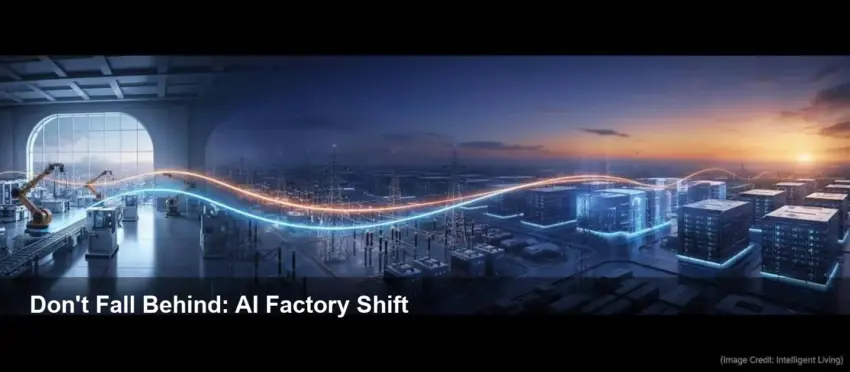
- Caterpillar and NVIDIA are collaborating to bring AI-driven factory systems to heavy-industry manufacturing.
- The partnership centers on digital twins, edge AI, and a new industrial software stack to optimize operations.
- Expected benefits include faster decision-making, predictive maintenance, lower downtime and improved safety.
- Challenges include integration with legacy equipment, data security, and workforce reskilling.
What the collaboration aims to build
Caterpillar and NVIDIA are combining strengths—Caterpillar’s industrial domain expertise and NVIDIA’s AI and computing platforms—to move manufacturing toward AI-native operations. The joint effort centers on three technical pieces: digital twins to model equipment and workflows, edge AI to run real-time analytics on-site, and a modern industrial software stack that ties data, models and controls together.
The goal is to let factories predict failures, optimize throughput, and make automated adjustments in near real time. Rather than sending every bit of data to the cloud, edge AI can filter, analyze and act locally, cutting latency and reducing bandwidth needs—critical for heavy-equipment environments and factories with intermittent connectivity.
Why this matters for manufacturers
Adopting digital twins and edge AI can change how decisions are made on the shop floor. Operators can simulate what-if scenarios, test process changes virtually, and validate outcomes before touching physical assets. Predictive maintenance reduces unexpected downtime and extends machine life; process optimization can lift output and reduce energy use.
For customers and suppliers, that translates into lower operating costs and faster response times. For manufacturers, it’s also a competitive imperative: companies that embrace AI-driven operations will likely outpace peers who rely only on manual monitoring and periodic maintenance.
Risks and real challenges
The technical promise comes with real caveats. Integrating new AI systems into plants that run legacy equipment is complex and costly. Data ownership and cybersecurity become more important as factories collect and share richer telemetry. There are also workforce implications—operators and engineers will need new skills to work with digital twins and AI assistants.
Stakeholders should watch for phased deployments that prioritize high-value use cases (for example, critical assets or bottleneck processes) and emphasize secure, standards-based interfaces to protect both data and uptime.
What to watch next
This collaboration reflects a wider shift: manufacturers increasingly view software, data and AI as core capital rather than add-ons. Expect more pilots, tighter hardware-software integrations, and proof-of-value projects aimed at reducing downtime and energy costs.
If you manage operations, the immediate takeaway is to inventory where AI and digital twins could remove the most pain—whether that’s unpredictable failures, slow changeovers, or quality variability. Ignoring the trend risks leaving a factory less efficient and slower to respond to market shocks.
Overall, the Caterpillar–NVIDIA plan signals that industrial AI is moving from concept to deployment. The biggest winners will be organizations that combine domain knowledge with a clear, staged path to adopt edge AI and digital twins safely.
Image Referance: https://www.intelligentliving.co/caterpillar-nvidia-ai-driven-factory/