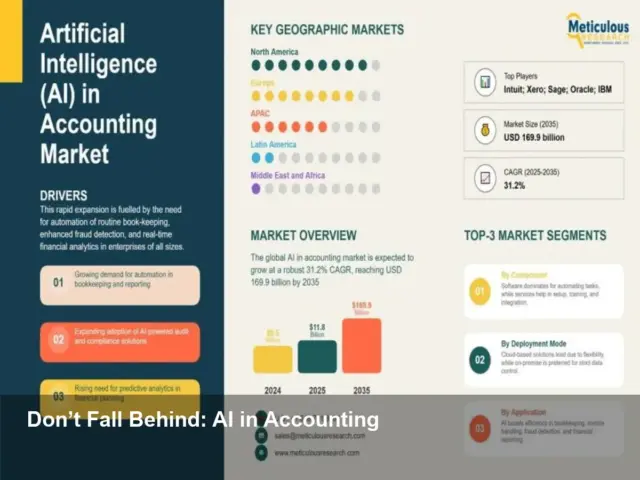
- Meticulous Research projects the AI in accounting market will reach USD 169.9 billion by 2035.
- Primary growth drivers named: process automation and tighter regulatory compliance.
- Firms that delay adoption risk higher costs, slower audits and falling behind competitors.
- The shift will affect audit, tax, bookkeeping and financial reporting workflows.
Report overview: a fast-growing market
Meticulous Research released a press briefing stating the AI in accounting market is expected to reach USD 169.9 billion by 2035. The headline number underlines how quickly finance teams are adopting machine learning, automation and analytics to handle routine bookkeeping, forecasting, audit preparation and regulatory reporting.
Why automation and regulatory compliance are pushing growth
The report highlights two clear forces driving demand. First, automation reduces time spent on repetitive tasks such as invoice processing, reconciliations and data entry — freeing accountants to focus on analysis and advisory work. Second, regulatory compliance is becoming more complex and data-intensive; firms are turning to AI to standardize reporting, detect anomalies and maintain audit trails.
These twin pressures create a strong use case across public accounting firms, corporate finance departments and small-to-medium practices. As regulations tighten and reporting cycles shorten, the ability to process large volumes of financial data quickly becomes a competitive advantage.
What this means for accounting teams and firms
Companies that adopt AI tools early can expect faster close cycles, improved error detection and more scalable audit capabilities. Conversely, firms that delay face real risks: higher labor costs, slower regulatory response times and weaker fraud detection.
Smaller firms may experience FOMO as larger competitors and early adopters advertise faster turnarounds and predictive insights for clients. For enterprise finance teams, integrating AI into existing ERPs and accounting stacks will be a critical technical and organizational challenge.
Practical impacts: where AI will show up first
- Audit and assurance: automated sampling, anomaly detection and evidence collection.
- Tax and regulatory reporting: automated mapping of transactions to reporting taxonomies.
- Accounts payable/receivable: intelligent invoice capture and exception handling.
- Financial planning and analysis: faster scenario modeling and forecasting.
How firms should respond
Leaders should treat this shift as strategic, not just tactical. Steps to consider: map high-volume manual processes, pilot AI tools in a controlled environment, invest in data governance and upskill staff for higher-value advisory roles. Vendors that offer prebuilt connectors to ERPs and clear compliance features will be preferred by risk-averse buyers.
Bottom line
The USD 169.9 billion projection signals a major industry transition: accounting is becoming more automated and data-driven. Firms that ignore this trend risk operational friction and competitive disadvantage, while those that act now can capture efficiencies, improve compliance and offer more strategic services to clients.
Note: This article summarizes a Meticulous Research press release on market size and drivers.
Image Referance: https://www.openpr.com/news/4381686/ai-in-accounting-market-to-reach-usd-169-9-billion-by-2035-driven