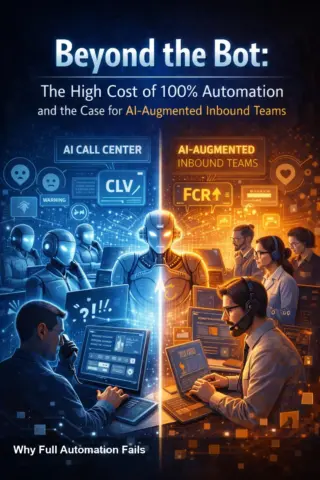
- Fully automating inbound customer interactions can backfire, harming customer experience and revenue.
- Hidden costs include lost sales, damaged loyalty, and escalation overhead.
- AI-augmented inbound teams — humans supported by AI — preserve empathy while improving efficiency.
- Practical steps: start with hybrid routing, measure outcomes, and train agents on AI tools.
Why the promise of 100% automation is tempting — and misleading
Automating inbound customer interactions with chatbots and voice bots promises lower costs and 24/7 coverage. That pitch is compelling for operations teams under pressure to cut expenses. But the reality for many customer‑facing organizations is more complicated: automation can handle routine requests well, but it often struggles with nuance, emotion and complex problem solving. When bots fail, customers escalate — and that creates hidden costs companies often overlook.
Hidden costs of fully automated inbound systems
Automating everything can introduce several risks:
- Friction and frustration: Customers who can’t get clear, timely answers will abandon tasks or defect to competitors.
- Revenue loss: Misrouted or poorly resolved inquiries can interrupt sales or renewal flows.
- Brand damage: Repeated poor interactions erode trust and word‑of‑mouth recommendations.
- Operational backstop: Failed bot handoffs lead to costly emergency staffing and longer handle times for human agents.
These are not speculative problems — they are practical consequences of removing the human element entirely from conversations that often require judgment, empathy and flexibility.
The case for AI‑augmented inbound teams
AI augmentation means using automation where it helps most — routing, summarization, suggested responses — while keeping humans in the loop for judgment calls. This hybrid model leverages strengths from both sides: AI speeds repetitive tasks and surfaces context; humans apply empathy, negotiate exceptions and rebuild trust when things go wrong.
Benefits of an AI‑augmented approach include faster resolution for common issues, fewer escalations for edge cases, and better overall customer satisfaction. It also reduces the risk of catastrophic failures that can occur when automation is the only option available.
How to transition: practical steps for businesses
- Map customer journeys to identify where automation adds value and where human judgment matters.
- Implement hybrid routing: let bots handle high‑confidence queries and seamlessly escalate uncertain cases to agents.
- Equip agents with AI tools — real‑time suggestions, conversation summaries and prioritized queues — rather than replacing them.
- Measure outcomes beyond cost: track CSAT, churn risk, conversion rates and long‑term loyalty.
- Iterate: use data from human‑handled interactions to improve bot accuracy and boundaries.
Why this matters now
Businesses that rush to remove human support risk short‑term savings but long‑term losses in customer trust and revenue. Conversely, organizations that adopt AI to augment inbound teams position themselves to scale without sacrificing experience. For customer‑centric companies, the smart path isn’t ‘bots or humans’ — it’s ‘bots plus humans’.
Choosing the hybrid route reduces risk, preserves empathy and often delivers better business outcomes. That balance is the practical future of inbound customer service.
Image Referance: https://aijourn.com/beyond-the-bot-the-high-cost-of-100-automation-and-the-case-for-ai-augmented-inbound-teams/