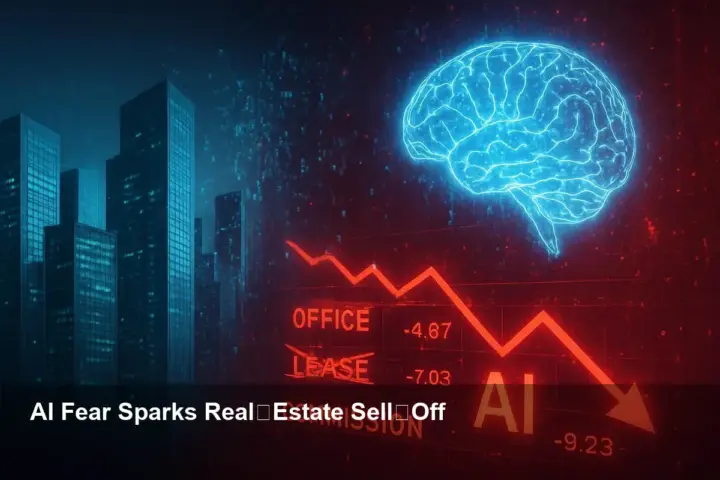
- Investors sold shares in large real‑estate service firms as fears about AI automation spread.
- The move has been labeled an “AI scare trade,” driven by concern that key service roles could be automated.
- Market watchers say the sell‑off reflects uncertainty about which companies can adapt and which will lose revenue.
- Analysts will watch earnings, AI investment announcements and guidance for signs the rout is over.
What happened
Stocks of major real‑estate service companies fell sharply after a wave of selling tied to concerns about artificial intelligence and automation. Traders and portfolio managers flagged the sector as particularly exposed: many companies provide services — transaction processing, valuations, property management and listings — that could be partially automated with advanced AI and process automation tools.
Why the “AI scare trade” matters
The force behind the move is psychological as much as technical. When investors fear a structural shift, they often move quickly to limit exposure, magnifying short‑term price moves. The result is a self‑reinforcing sell‑off: headlines about AI risk prompt selling, which in turn triggers more headlines and more selling.
Sector vulnerability
Real‑estate services include many repeatable, data‑driven tasks. That makes the sector attractive for AI solutions promising cost savings and speed. But that same promise creates uncertainty about future revenue and margins for incumbent firms — especially those that rely heavily on labor or standardized processes.
What investors and companies are watching now
Market participants say several signals will determine whether the rout continues or stabilizes:
- Quarterly earnings and management guidance showing revenue resilience or weakness.
- Announcements of AI investments or partnerships that suggest firms can adapt and capture new efficiencies.
- Regulatory or legal developments that could slow or shape deployment of automation in property markets.
- Hiring trends and cost‑cutting plans revealing whether companies expect lower headcounts or higher productivity.
How firms can respond
Companies that clearly set out pragmatic AI strategies — testing automation in back‑office functions, retraining staff for higher‑value roles and protecting customer relationships — may recover investor confidence faster. Conversely, firms that appear passive or vulnerable to margin pressure could remain under selling pressure until they prove their plans.
Bottom line
The “AI scare trade” highlights a core market tension: investors must weigh short‑term disruption against long‑term opportunity. For now, uncertainty is driving volatility in real‑estate service stocks. The coming weeks of earnings reports, strategic announcements and regulatory signals should clarify which companies will adapt and which may struggle.
Image Referance: https://markets.financialcontent.com/stocks/article/marketminute-2026-2-12-the-ai-scare-trade-real-estate-service-giants-plunge-as-automation-fears-grip-wall-street