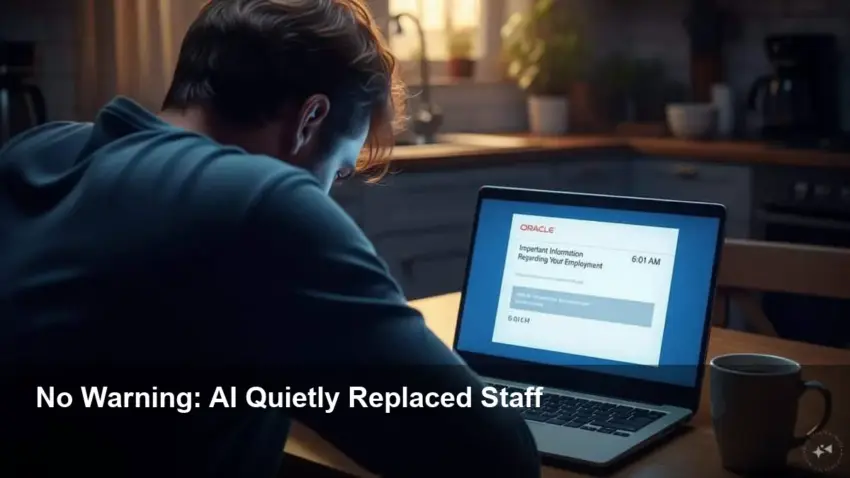
- Former Oracle employee says he was replaced by automation with “no warning” and no exit discussions.
- A wave of sudden layoffs at Oracle has left thousands unsettled as the company focuses on AI infrastructure.
- The move raises questions about organisational trust, employee protections and whether innovation is being prioritised over people.
What happened
A former Oracle employee has described being replaced by automation without prior warning or an exit conversation. The claim comes amid a broader, sudden round of layoffs at the company, which a short report linking the case to Oracle’s intensified investment in AI infrastructure and automation.
Why this matters
When companies shift roles to automated systems quickly and without transparent communication, the consequences go beyond lost jobs. Workers report loss of trust, reduced morale among remaining staff, and heightened anxiety about career stability. For employers, a stealthy approach to workforce change can damage reputation and make it harder to recruit and retain talent — especially in tight labour markets for tech skills.
How the shift to AI is being framed
Oracle’s strategy, as described in reporting around these developments, emphasises building AI infrastructure and automated systems. For organisations, automation often brings genuine efficiency gains and the ability to scale services. But when that transition lacks clear policies for retraining, redeployment, or fair exit procedures, it creates friction: employees feel sidelined and the public narrative shifts toward prioritising technology over people.
Reactions and potential impacts
Public reaction to stories like this typically focuses on three areas: immediate harm to displaced workers, the longer‑term cultural effect inside the company, and broader industry impulses. Sudden layoffs without clear explanation can prompt regulatory scrutiny, worker activism and calls for stronger corporate governance. Even if no legal breach occurred, the perceived fairness of a company’s process matters to customers, partners and prospective hires.
What workers and employers can do
Workers affected by automation have limited short‑term options, but several actions can help reduce risk: proactively track internal role shifts, document performance and communications, upskill toward AI‑adjacent roles, and seek clarity from HR about redeployment policies. Employers that want to avoid reputational damage should prioritise transparent communication, fair exit procedures and meaningful reskilling programs when automation becomes part of a workforce strategy.
The bigger picture
The case described by the former Oracle employee is a flashpoint in a larger industry debate: how to balance rapid technological progress with responsibilities to employees. As more firms adopt automation, the choices companies make about process and communication will shape not only immediate outcomes for affected staff but also trust and stability across the sector.
Image Referance: https://www.firstpost.com/tech/no-warning-no-exit-talks-just-ai-former-oracle-employee-reveals-how-automation-quietly-replaced-him-at-work-ws-e-13999715.html