
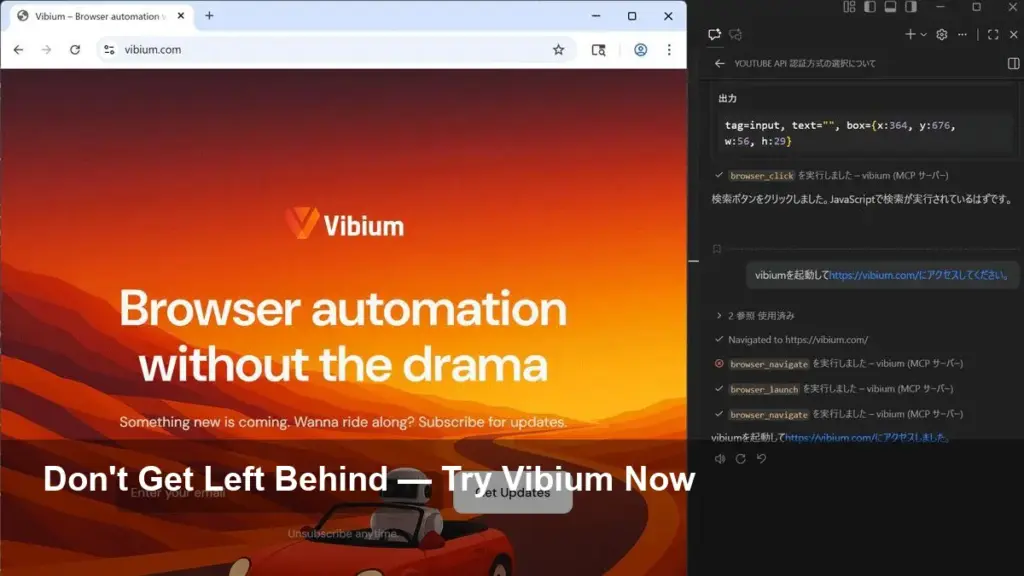
Key points
- Vibium is a new browser automation project launched by the creator of Selenium, aimed at serving both AI agents and human users.
- It promises to bridge classical automation (human scripting) with emerging AI-driven agents, emphasizing reliability and cross-browser compatibility.
- Designed for developers and organizations that need deterministic browser control for testing, scraping, and agent-driven workflows.
- Early adoption could offer a competitive edge — the tool is already attracting attention because of its pedigree.
Vibium bridges AI agents and human automation
Vibium, unveiled by the creator of Selenium, positions itself as a next-generation browser automation toolkit that supports both human-driven scripts and AI agents. Where older tools focused primarily on testing and scripted interactions, Vibium aims to unify manual automation patterns with autonomous agent behaviors — a response to the growing use of large language models and AI agents that need reliable browser control.
Why this matters
Automation is rapidly evolving. Traditional browser automation tools were built for testing and repeatable human actions; now, AI agents expect programmatic access to web pages, user interfaces, and complex workflows. Vibium is notable because it comes from the team behind Selenium — giving it early credibility and attracting attention from developers wary of immature AI integrations.
Core goals and expected capabilities
- Reliable cross-browser control: an emphasis on consistency across Chromium, Firefox and other engines.
- Agent-friendly APIs: designed so AI agents can interact with pages in a deterministic, observable way.
- Human-friendly tooling: record/playback, debugging utilities and clear developer ergonomics for scripted tasks.
- Extensibility and performance: built to be embedded into pipelines for testing, scraping, and autonomous agents.
What experts are watching
Industry watchers are paying attention for two main reasons: first, the pedigree of the project’s creator gives it social proof; second, if Vibium can deliver stable APIs for AI agents while maintaining the reliability expected by human developers, it could become a standard for hybrid automation workflows.
Potential use cases
- Automated UI testing with improved stability for flaky elements.
- LLM-driven agents performing multi-step, web-based tasks securely and reliably.
- Enterprise automation pipelines that combine human-triggered runs and autonomous agents.
- Data extraction and monitoring where robust handling of dynamic content matters.
How to approach Vibium as it lands
If you’re responsible for QA, automation engineering, or building AI agents that interact with the web, consider evaluating Vibium early. Focus on compatibility with your browsers, the maturity of APIs, debugging tools, and how it handles real-world, flaky page behavior. Early adopters often gain operational insights and competitive advantage — but validate stability before shipping mission-critical workflows.
For now, Vibium is a compelling development in the automation space: it promises to combine the reliability required by developers with the new demands of AI-driven agents. Given its origins, it’s a project worth watching closely.
Image Referance: https://gigazine.net/gsc_news/en/20260111-vibium/