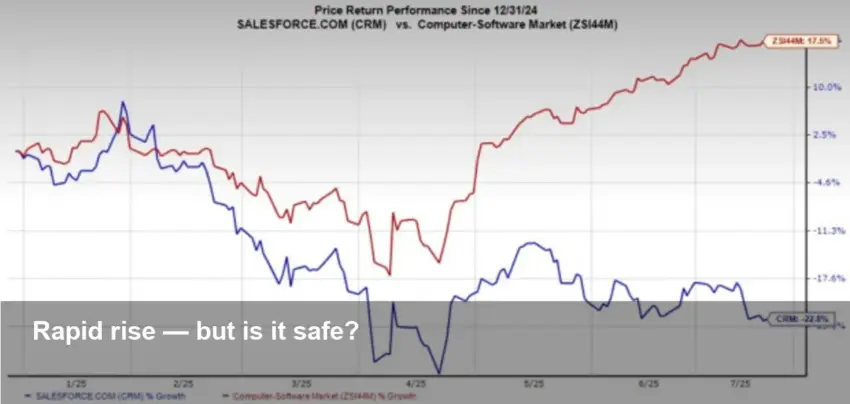
- Salesforce is making a major strategic bet on Agentforce, an AI agent platform meant to automate business tasks.
- Within two quarters of launch, Agentforce has signed more than 4,000 paid deals and surpassed $100 million in annual recurring revenue (ARR).
- The platform promises productivity gains across CRM workflows but raises questions about integration, data governance and long‑term ROI.
- Customers should test Agentforce on low‑risk processes and measure outcomes closely before broad rollout.
What Agentforce is and why it matters
Agentforce is Salesforce’s new platform for AI‑powered software programs — called AI agents — that automate routine business tasks inside CRM and related workflows. According to Salesforce’s public disclosures, the offering has seen unusually fast commercial traction: within two quarters of launch it had signed over 4,000 paid deals and reached more than $100 million in annual recurring revenue.
That pace of adoption gives Agentforce instant social proof: customers are buying, and the product is already generating substantial recurring revenue. For Salesforce, the platform is being positioned as a potential next major growth engine as buyers look to AI to reduce costs and accelerate sales, service and other operations.
Early wins — and what they don’t yet prove
Rapid revenue and deals are strong early indicators, but they are not the whole story. Fast adoption can reflect heavy pilot promotions, bundled offers, or concentrated wins in certain customer segments. What matters next is whether organizations see sustained productivity gains and measurable ROI after initial deployments.
For business leaders, the immediate appeal is clear: AI agents can complete repetitive tasks, trigger workflows, summarize information and surface next actions without constant human oversight. That promise feeds FOMO — companies worry they’ll fall behind competitors who automate faster.
Risks, open questions and red flags
Negativity bias is useful here: big promises come with real risks. Key concerns customers should watch for include:
- Data governance and privacy: AI agents often need broad data access to operate effectively. That raises questions about how data is stored, shared and audited.
- Integration complexity: tying agents into existing CRM customizations and legacy systems can be harder than vendor demos suggest.
- Accuracy and trust: automation can introduce errors or biased decisions if models aren’t tuned for specific business contexts.
- Hidden costs: scaling beyond pilots may require professional services, monitoring, and change management.
What customers and competitors can expect
Customers considering Agentforce should start small: deploy agents in low‑risk tasks, define clear success metrics, and validate outcomes before expanding. Procurement and IT teams should insist on robust SLAs, explainability of agent actions, and transparent billing terms.
Competitors and partners will watch whether Agentforce’s early ARR and deal volume translate into sustained growth and deeper product adoption across Salesforce’s ecosystem. If it does, the platform could reshape expectations for CRM automation — but if integration and governance issues crop up, enthusiasm could cool quickly.
Bottom line
Salesforce’s bet on Agentforce is already paying off in the short term with significant paid adoption. The bigger question is whether the platform can convert early momentum into durable, enterprise‑scale value without creating new risks. For now, the message to buyers is clear: test rigorously, demand transparency, and measure real business impact before you commit at scale.
Image Referance: https://www.msn.com/en-us/money/other/salesforce-bets-big-on-agentforce-can-ai-agents-power-growth/ar-AA1IMF05?apiversion=v2&noservercache=1&domshim=1&renderwebcomponents=1&wcseo=1&batchservertelemetry=1&noservertelemetry=1