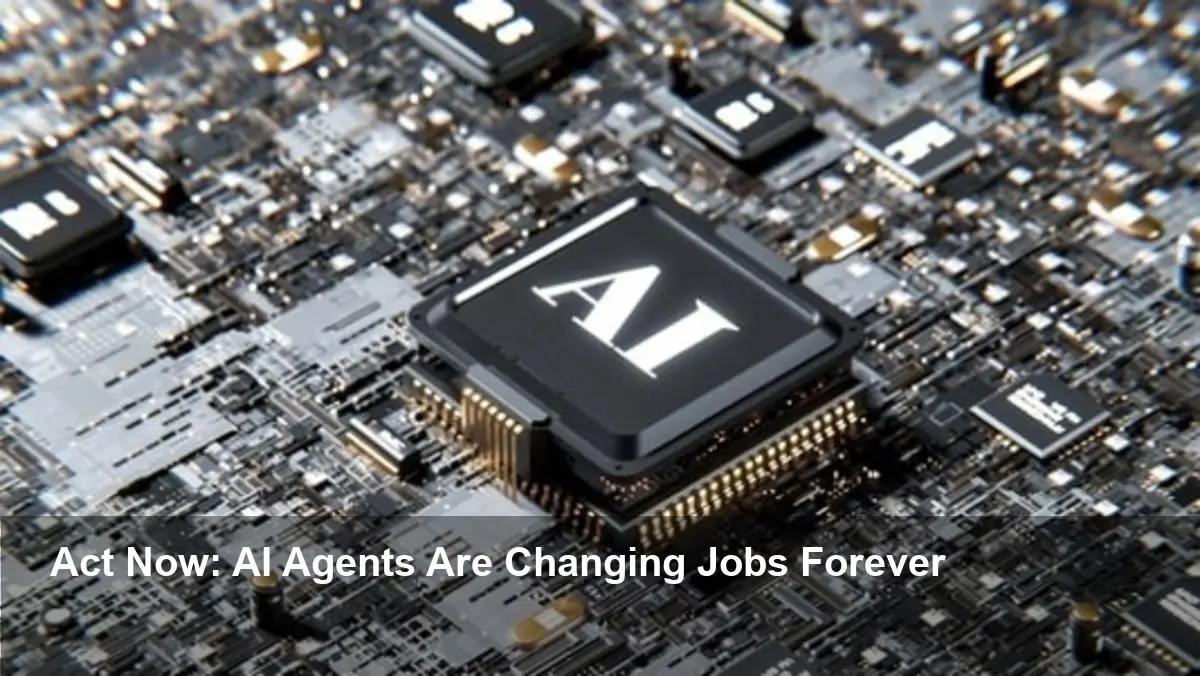
- AI agents are autonomous software systems that can plan, act and learn — transforming routine and knowledge work.
- Companies adopting AI agents report faster execution and lower costs, but experts warn of job shifts, bias and security gaps if unmanaged.
- Reskilling, governance and human–agent collaboration are the immediate priorities to capture benefits while limiting harm.
AI agents: The quiet revolution redefining the future of work
By Jayanth Rasamsetti, founder CEO & chief AI scientist, Pixeltests, Hyderabad
What are AI agents?
AI agents are increasingly autonomous software programs that perceive environments, set goals, plan actions and iteratively learn from outcomes. Unlike single-purpose automation, modern agents combine language models, planning modules and external tools to perform multi-step tasks — from drafting emails and managing calendars to triaging support tickets and orchestrating software builds.
Why this matters now
Because these agents can operate 24/7, integrate across tools and improve through feedback, they are quietly reworking the division of labor. Businesses using agents report faster turnaround, fewer manual handoffs and lower operational costs. For knowledge workers, agents can eliminate repetitive work and surface higher-value tasks — but they also shift required skills.
Real-world use cases
- Customer service agents that resolve common queries end-to-end and escalate only complex cases to humans.
- Developer copilots that generate code, run tests and suggest fixes, accelerating delivery cycles.
- Sales and marketing agents that personalize outreach at scale and optimize follow-ups based on engagement data.
- Operational agents that monitor systems, file incident tickets and coordinate cross-team responses automatically.
Risks and limitations
Adoption isn’t risk-free. Key concerns include:
- Job displacement and role redefinition — some tasks will disappear while new roles emerge.
- Bias, hallucinations and incorrect actions — agents can amplify errors unless monitored.
- Security and privacy gaps — automated access to systems increases attack surface if credentials and data controls are weak.
- Overreliance — blind trust in agents can erode human oversight and degrade outcomes.
How organizations should respond
To harness agents safely, leaders should:
- Establish governance: set policies for agent permissions, audit trails and human-in-the-loop checkpoints.
- Prioritize reskilling: train teams in agent orchestration, prompt engineering and verification.
- Start small, scale fast: prototype agents on high-value, low-risk processes and expand with measurable SLAs.
- Measure outcomes: track productivity, error rates and employee experience to guide deployments.
Bottom line
AI agents represent a quiet but rapid shift in how work gets done. Organizations that act decisively — combining technical controls, workforce investment and ethical governance — will capture outsized benefits. Those that delay risk being overtaken by competitors who are already building the next generation of autonomous work partners.
No social media or YouTube embeds were included in the provided source.
Image Referance: https://www.msn.com/en-in/money/news/ai-agents-the-quiet-revolution-redefining-the-future-of-work/ar-AA1SgSa7?ocid=finance-verthp-feeds