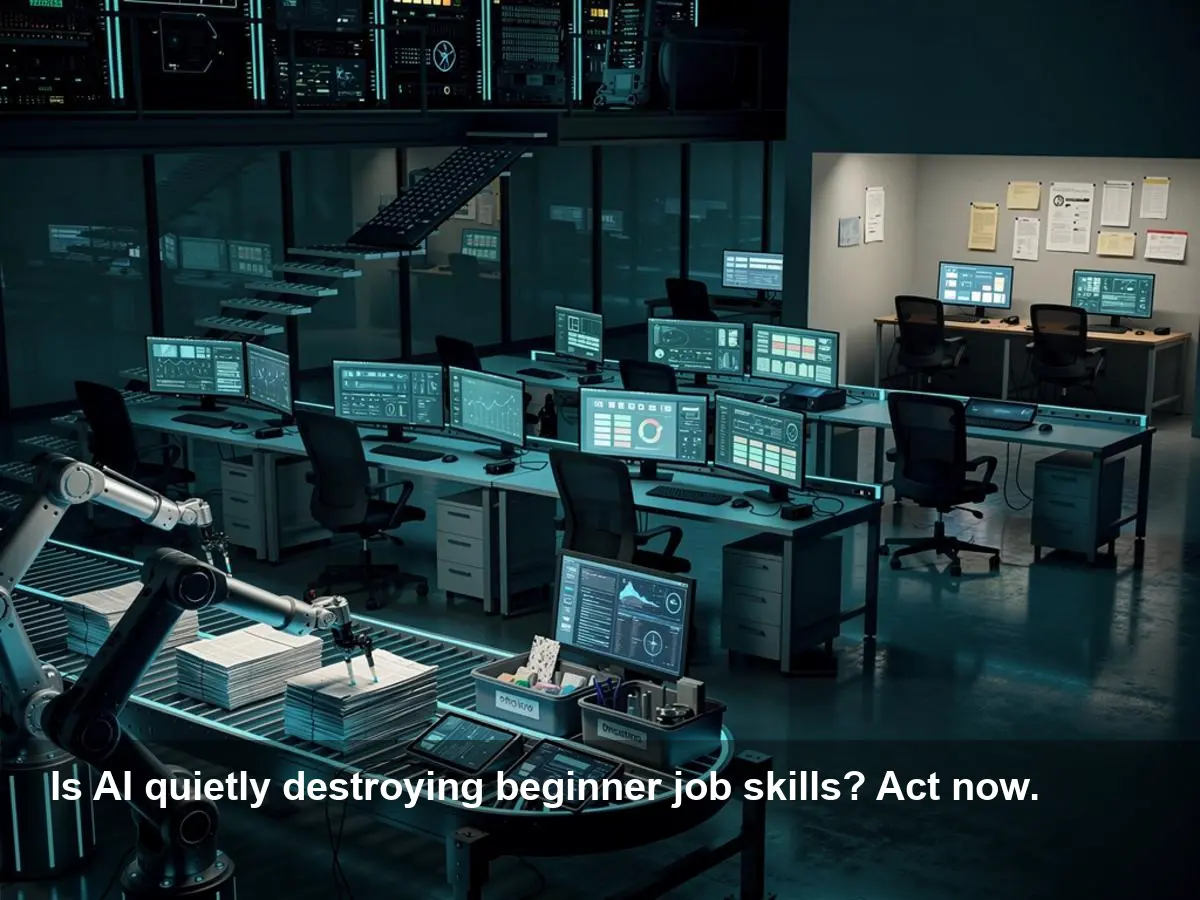
- AI automates repetitive “grunt” work across industries, boosting speed but removing routine training opportunities.
- Experts warn the technology may erode foundational skills that entry-level workers traditionally develop on the job.
- Companies should redesign training, rotate tasks, and invest in upskilling to prevent a long-term skills gap.
- No social media embeds or YouTube videos were present in the source material.
AI Removes Repetition — And With It, Learning
What’s happening
AI tools are increasingly used to automate repetitive, low-complexity tasks—data entry, basic customer responses, routine document review—that historically provided an on-ramp for new workers. While automation improves speed and reduces errors, industry observers caution it also strips away a crucial phase of workplace learning: repeated exposure to fundamentals that build judgement and transferable skills.
Why entry-level training is at risk
Entry-level roles traditionally function as training grounds. Repetition and small mistakes teach process, pattern recognition, and how to escalate issues. When AI handles these tasks, newcomers may never face the incremental challenges that develop resilience, problem-solving, and a sense of professional context.
Signs already emerging
Employers report faster throughput and lower error rates, and many teams celebrate productivity gains. But several HR leaders and career coaches are noting a parallel trend: junior hires who have technical knowledge but limited applied judgement and workplace instincts. This mismatch can slow career progression and increase reliance on senior staff for routine decisions.
The broader consequences
Neglecting the learning function of entry-level work risks creating a workforce with narrow capabilities. Organizations could see bottlenecks in mid-level roles, higher turnover among frustrated juniors, and an overburdened senior cohort. Economically, this may shift training costs onto companies later in a worker’s career or force more extensive external retraining programs.
What employers can do
- Redesign roles: Preserve a mix of automated and human tasks so new hires still encounter teachable moments.
- Task rotation: Move juniors through short stints across functions to broaden experience.
- Structured mentoring: Pair automation with deliberate coaching to translate output into learning.
- Upskilling investments: Offer training that focuses on judgement, communication, and systems thinking — skills AI cannot replicate easily.
Policy and education responses
Policymakers and educators should monitor labor market shifts and support apprenticeships and vocational programs that emphasize applied experience. Incentives for businesses that maintain learning-first entry roles could help sustain a pipeline of skilled workers.
Conclusion
AI’s ability to eliminate grunt work delivers clear short-term gains, but without intentional design of roles and training, it risks hollowing out the experiential learning that builds career-ready employees. Companies that proactively preserve and reframe learning opportunities will likely gain a long-term competitive edge, while those that don’t could face costly skill gaps down the line.
Image Referance: https://www.webpronews.com/ai-automates-grunt-work-risks-eroding-skills-in-entry-level-jobs/