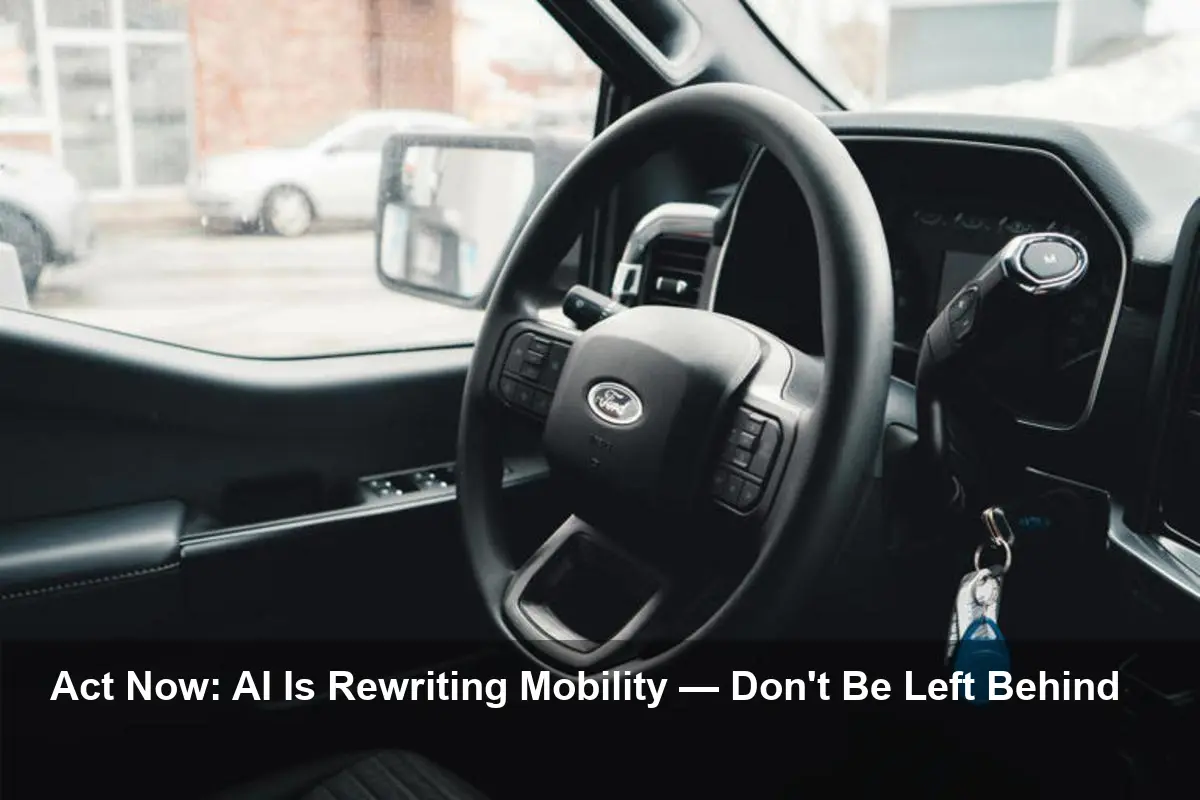
- AI has moved from pilot projects to a foundational layer across modern mobility platforms.
- Operators use AI for route optimization, predictive maintenance, pricing and safety, driving measurable cost and efficiency gains.
- The shift introduces new operational, regulatory, and workforce challenges that require data governance, edge computing and strategic partnerships.
How AI Automation Is Reshaping Modern Mobility Platforms
Artificial intelligence is no longer an adjunct experiment in transportation technology — it has become the backbone of modern mobility platforms. Companies ranging from ride-hailing services and logistics fleets to public transit agencies are embedding AI at every layer: orchestration, vehicle control, customer experience and operations. That shift is changing how trips are planned, vehicles are managed and services are monetized.
Key AI use cases transforming mobility
Route optimization and dynamic dispatch
Real‑time routing powered by machine learning reduces empty miles and wait times. Dynamic dispatch models that continuously learn from demand patterns increase utilization for shared fleets and delivery networks.
Predictive maintenance and asset uptime
AI models analyze telemetry and sensor streams to predict failures before they occur. Predictive maintenance extends vehicle life, lowers repair costs and keeps fleets available during peak demand.
Autonomy and driver-assist systems
Advanced perception and control algorithms are accelerating the deployment of driver-assist and autonomous features. Even partial automation reduces accidents and labor dependence while demanding new safety validation and regulatory compliance.
Pricing, demand forecasting and personalization
Dynamic pricing models and demand-forecasting algorithms help platforms balance supply with demand and personalize offers, improving revenue per ride and customer retention.
Operational and business impacts
Embedding AI across the stack yields concrete gains: lower operating costs, higher fleet utilization, faster response times and improved safety metrics. The result is a new competitive hierarchy: platforms that effectively integrate AI gain scale advantages, better margins and stronger customer loyalty.
Challenges and risks to address
Data quality, governance and privacy
AI depends on high‑quality, labeled data. Firms must invest in instrumented fleets, secure telemetry pipelines and governance frameworks to ensure models remain accurate and compliant with privacy rules.
Edge computing and connectivity
Real-time decisions often require edge processing and resilient connectivity. Architectures must balance cloud model training with on-vehicle inference and fallback strategies for degraded networks.
Workforce transformation and regulation
Automation changes job profiles across operations, maintenance and customer service. Companies must reskill workers and engage regulators proactively to shape safe, scalable deployments.
What mobility leaders should do now
Prioritize strategic pilots with measurable KPIs
Move beyond proof-of-concept: run focused pilots tied to utilization, downtime, cost-per-mile or safety outcomes and scale the models that deliver repeatable ROI.
Build partnerships and modular stacks
Pair in-house capabilities with specialist vendors for perception, mapping, or fleet orchestration. Modular platforms reduce vendor lock‑in and accelerate updates.
Invest in governance, testing and resilience
Adopt robust model validation, continuous testing and incident response playbooks so AI behaviors remain predictable under real-world conditions.
AI automation is reshaping mobility from incremental improvement to structural change. Organizations that act now — aligning data, compute and organizational skills — will capture outsized benefits; those that delay risk being outcompeted as the technology becomes the standard operating layer for modern transportation.
Image Referance: https://www.msn.com/en-us/news/technology/how-ai-automation-is-reshaping-modern-mobility-platforms/ar-AA1THJjK