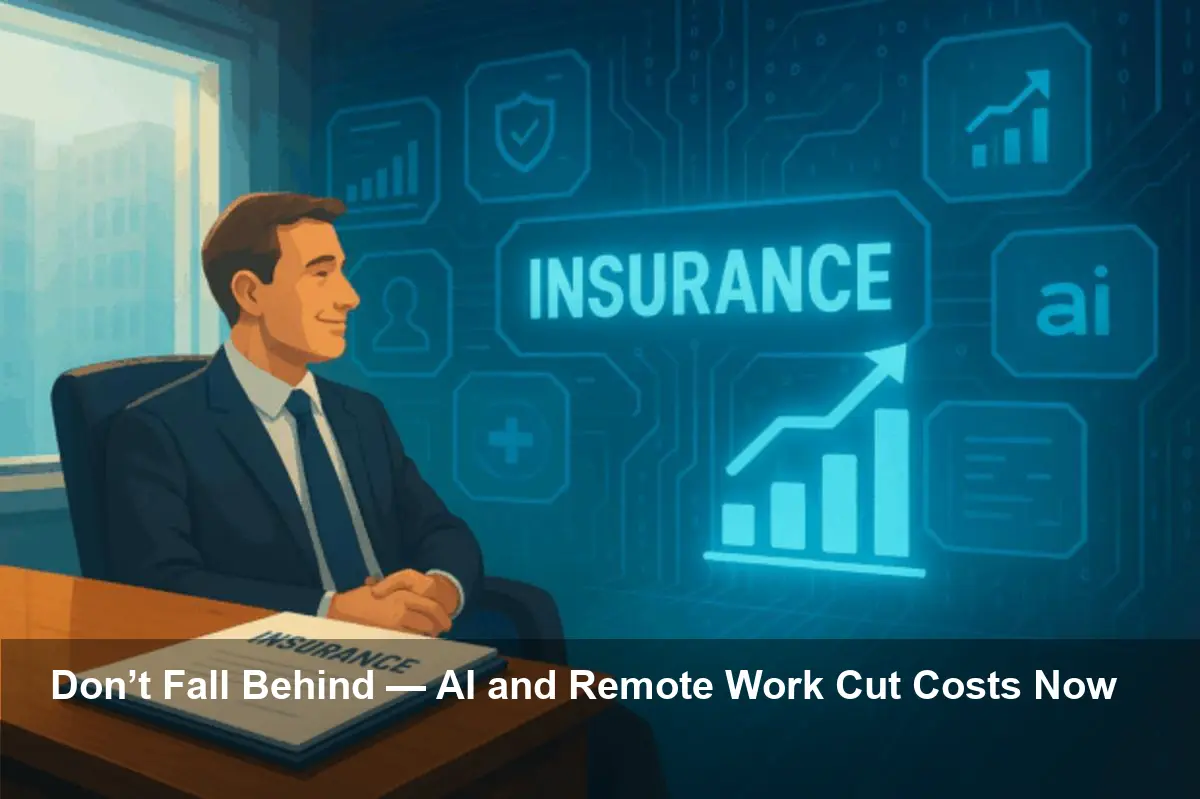
- AI and automation are driving measurable expense reductions across property/casualty (P/C) insurers.
- Remote work and lower occupancy costs are improving operating-expense ratios.
- Gains come with tradeoffs: cybersecurity, talent gaps and regulatory scrutiny remain risks.
- Insurers that delay adoption risk falling behind competitors and investors seeking efficiency.
AI and Remote Work Push P/C Insurers Toward Leaner Expense Ratios
Carrier Management analysis finds structural cost improvements
Carrier Management’s recent review of industry results shows property/casualty insurers are reporting steadier expense-ratio performance thanks to two structural shifts: broader deployment of artificial intelligence (AI) and the persistence of remote or hybrid work models. Together, these forces are reshaping the insurers’ operating-cost profile and delivering near-term relief to expense ratios.
How AI is cutting costs
Insurers are applying AI across underwriting, claims and back-office functions. Automation reduces manual processing, accelerates claims handling, and improves fraud detection — all of which lower per-policy servicing costs. AI-driven workflow tools and decision support systems also free experienced staff from repetitive tasks, enabling leaner teams without sacrificing throughput.
Remote work reduces fixed operating expenses
Widespread remote and hybrid work has shrunk real-estate needs and related overhead such as utilities, on-site services and in-office equipment. For many insurers, this has translated to lower occupancy and facility expenses, which in turn improves the operating-expense component of the expense ratio.
Improvements are meaningful — but not uniform
While the overall trend favors lower expense ratios, results vary by carrier size, legacy infrastructure and speed of technology adoption. Insurers that invested early in cloud platforms, digital claims portals and AI models tend to show bigger margin improvements. Conversely, firms still dependent on paper-based workflows or rigid legacy systems have seen smaller gains.
Risks and caveats
Expense-ratio improvement can mask other vulnerabilities. For example, heavy automation increases reliance on third-party vendors and technology partners, elevating concentration and cyber risk. Remote work complicates supervision and cultural cohesion, creating potential operational and compliance gaps. Regulators and rating agencies are attentive to how cost cuts affect reserving practices and long-term service quality.
What this means for insurers and policyholders
Executives should view AI and remote work as strategic levers to improve efficiency, but pair cost initiatives with strong risk controls, cybersecurity investments and talent-management programs. For investors and market observers, the shift signals that carriers that embrace modernization are likely to post sustained expense advantages — while laggards may face competitive pressure.
Bottom line
AI and remote work are not just trends; they are catalysts for real expense-ratio improvement in the P/C sector. The winners will be carriers that combine technology adoption with disciplined risk management. Those that delay risk falling behind industry peers and investor expectations.
Image Referance: https://www.carriermanagement.com/news/2026/01/12/283239.htm