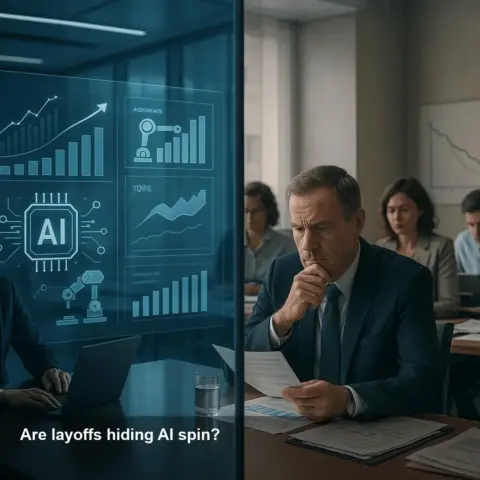
- Companies have announced more than 50K layoffs and many cite AI as the reason.
- Forrester warns that numerous firms lack mature systems needed for large-scale automation.
- Experts say the “AI excuse” risks masking traditional cost-cutting and puts workers at sudden risk.
- Watch for auditability, measurable automation ROI, and evidence of reskilling programs before accepting AI explanations.
What happened — and why the phrase “AI-washing” matters
Companies across sectors have attributed recent, large-scale job cuts — totaling more than 50K roles — to advances in artificial intelligence and automation. That explanation has become so common that analysts and journalists have started calling it “AI-washing”: using AI as a convenient narrative to justify workforce reductions or strategic pivots.
Forrester has pushed back on the headline narrative, warning that many organizations don’t yet have the mature systems required to replace human roles with reliable automation at scale. In other words, the technology explanation may be incomplete or premature.
Why this discrepancy is important
When companies claim AI is the driver of layoffs but lack robust automation platforms, several risks emerge:
- Accountability and transparency: Leaders may be using AI as a reputational shield to deflect from other motives, such as cost-cutting or restructuring.
- Worker impact: Employees lose jobs based on a promise of automation that may never materialize, leaving gaps in income and career plans.
- Investor signaling: Companies can signal future efficiency gains to markets even if the technical groundwork isn’t in place, which can distort expectations and valuations.
- Regulatory and ethical scrutiny: If AI is invoked without demonstrable results, regulators and labor groups may push for clearer disclosure and oversight.
How to tell if automation claims are credible
Not every claim of “AI-enabled” change is false, but the gap between marketing language and technical readiness can be wide. Look for these signs that automation is real and responsibly deployed:
- Evidence of production systems: Are AI models and automated workflows running in production with measurable outcomes, not just pilots?
- Measurable ROI and metrics: Does the company publish or disclose specific KPIs showing automation reduced labor needs while maintaining quality?
- Reskilling and transition plans: Are affected workers offered retraining, redeployment, or support, or are cuts abrupt and uncompensated?
- Third-party audits or certifications: Independent validation of systems and outcomes reduces the risk of misleading claims.
What this means going forward
For employees, investors, and policymakers, the immediate takeaway is caution. Companies should be pressed for evidence when citing AI as the cause of layoffs. Forrester’s warning suggests many organizations are still on the journey to automation maturity — and that claiming AI as the primary driver of mass job cuts without proof risks eroding trust.
Expect closer scrutiny from journalists, analysts, and regulators. The debate will likely shift from whether AI can change work to how companies prove that change is real, measurable, and fair to the people affected.
Image Referance: https://www.techbuzz.ai/articles/ai-washing-exposed-are-50k-layoffs-really-about-automation