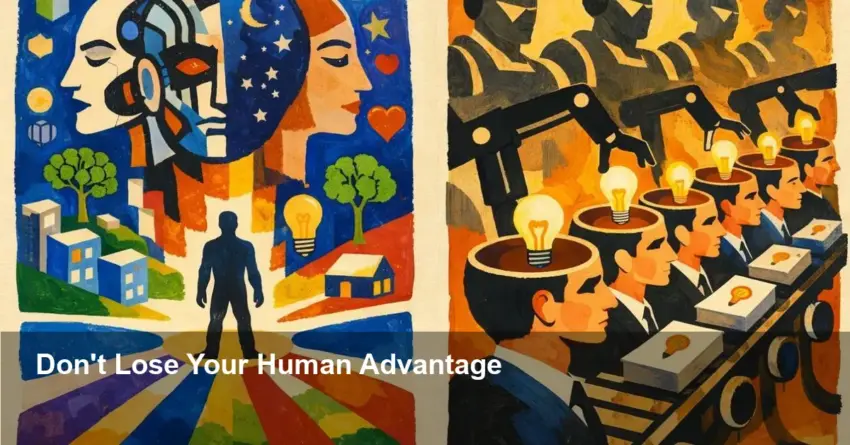
- Automation and augmentation are now competing forces shaping work and decision-making.
- People who deliberately control AI retain agency; passive use risks erosion of influence.
- Your behavioral signature—unique choices, style and judgment—grows more valuable as AI standards homogenize outputs.
- Practical steps can help individuals amplify what machines cannot replicate.
What the automation‑augmentation paradox means
The automation‑augmentation paradox describes a growing tension: AI systems can replace routine tasks (automation) while also promising to extend human capabilities (augmentation). The paradox is that the more capable AI becomes, the more pressure there is to cede control — even when retaining control is precisely what preserves human value.
A recent Psychology Today piece framed this trade‑off: those who treat AI as a tool they deliberately control maintain agency, while passive reliance risks letting AI’s standards dictate behavior.
Why your behavioral signature matters
Behavioral signature refers to the consistent patterns in how you make decisions, communicate, prioritize, and solve problems. As AI models standardize language, formatting and decision heuristics, those human patterns stand out. That contrast can make an individual more recognizably valuable to employers, clients and collaborators.
Put simply: when outputs become similar because many people use the same AI defaults, individuality becomes a scarce signal. That scarcity translates into professional advantage for people who cultivate and make their style visible.
What’s at risk — and who should care
Negativity bias is useful here: passively accepting automation can erode judgment, reduce critical thinking and obscure accountability. Teams that outsource decisions to models without oversight risk legal, ethical and reputational fallout. Knowledge workers, creative professionals and leaders face the biggest stakes because their roles depend on distinct judgment.
How to preserve agency and amplify value
1. Use AI deliberately, not reflexively
Treat AI as an assistant with clear boundaries. Before asking a model for help, define the decision you own and the parts you’re outsourcing.
2. Make your process visible
Document why you chose an option, what you rejected and how you judged trade‑offs. That record highlights your behavioral signature and helps others trust your work.
3. Customize and reject defaults
Avoid one‑click prompts that encourage homogenized outputs. Tweak models, prompts and templates to reflect your perspective and voice.
4. Train colleagues and set norms
Create team rules for when automation is allowed and when human sign‑off is required. Social proof (colleagues adopting deliberate use) reinforces better habits.
Why this matters now
AI is accelerating. The choice is not whether to use it, but how to use it. Those who consciously control AI will preserve agency and turn their behavioral signature into a competitive edge—while passive users risk becoming indistinguishable from the tools they rely on.
Image Referance: https://www.psychologytoday.com/us/blog/harnessing-hybrid-intelligence/202601/from-ai-augmentation-to-automation-or-amplification/amp