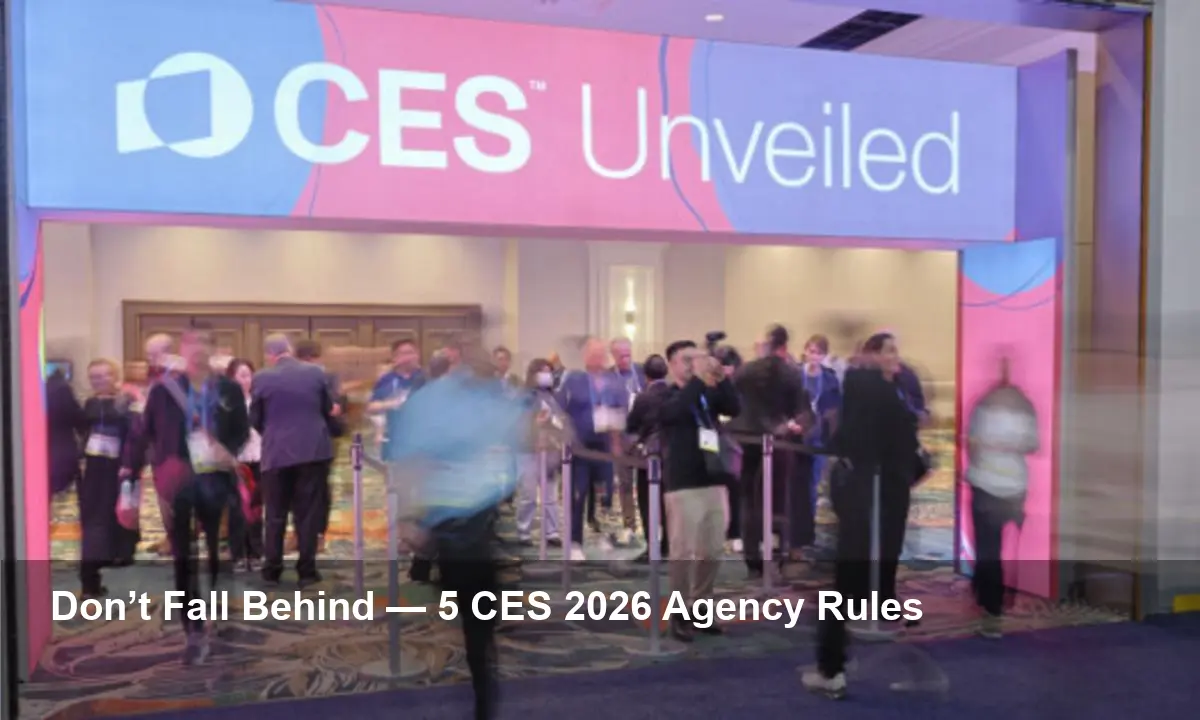
- Agencies at CES 2026 prioritized speed, control and transparency as strategic imperatives.
- Five core trends emerged: AI-powered creative workflows, broader automation, owned tech stacks, improved media transparency, and governance/control.
- Agencies are investing in first-party data and proprietary stacks to reduce vendor dependency and sharpen measurement.
- Expect faster creative iteration, clearer media attribution, and more centralized operational control across ad and production pipelines.
CES 2026: Agencies scale smarter with AI, automation and control
Summary
At CES 2026, agency leaders and vendor partners signaled a decisive shift: growth now depends on combining creative talent with rigorous automation, AI-driven workflows and more control over technology stacks. The conference highlighted five trends that are shaping how agencies deliver faster creative, clearer media transparency and stronger operational control.
1. AI becomes embedded across creative workflows
AI moved beyond isolated demos to practical integration across ideation, production and optimization. Agencies described using generative models to accelerate concepting, automate editing and produce multiple creative variants for rapid testing. The result: creative velocity increases while human teams focus on strategy, quality control and storytelling.
2. Automation and orchestration at scale
Automation was framed as orchestration: connecting tools, data and approval gates so work flows predictably from brief to delivery. Low-code automation platforms, workflow engines and API-first tools were spotlighted as ways to eliminate manual handoffs, reduce time-to-market and cut error rates in campaign execution.
3. Investing in owned tech stacks and first-party data
Privacy-driven measurement changes and rising media costs are pushing agencies toward owned infrastructure. Agencies spoke about building proprietary stacks—tagging, analytics, creative ops and media orchestration—that centralize first-party signals. Owning the stack offers greater control over measurement, reduces vendor leakage and supports long-term client value.
4. Media transparency and measurement demand clarity
Advertisers and agencies alike emphasized the need for clearer media supply transparency. CES conversations focused on better visibility into programmatic paths, fees and outcomes, and on deploying cookieless measurement strategies that still deliver actionable attribution. Agencies are packaging transparency as a competitive differentiator.
5. Governance, ethics and control frameworks
As AI use grows, so does scrutiny. Firms outlined governance frameworks for model use, data stewardship and creative approvals to manage risk and brand safety. Establishing clear policies and control points was framed as essential to scale AI responsibly.
What this means for agencies and clients
Short term: expect faster creative cycles, more test-and-learn campaigns, and tighter integration between media and creative teams. Medium term: agencies that invest in owned stacks and robust automation will likely see cost efficiencies, improved measurement and stronger client retention. Long term: the winners will be teams that combine human judgment with scalable, transparent systems.
Bottom line
CES 2026 confirmed a practical, less speculative turn in agency tech: AI and automation are now tools for operational control and creative acceleration. Agencies that move quickly to standardize workflows, own critical data, and prioritize transparency will gain a measurable competitive edge.
No embedded social media or video content was present in the provided material.
Image Referance: https://news.designrush.com/ces-2026-agency-trends-ai-automation-control