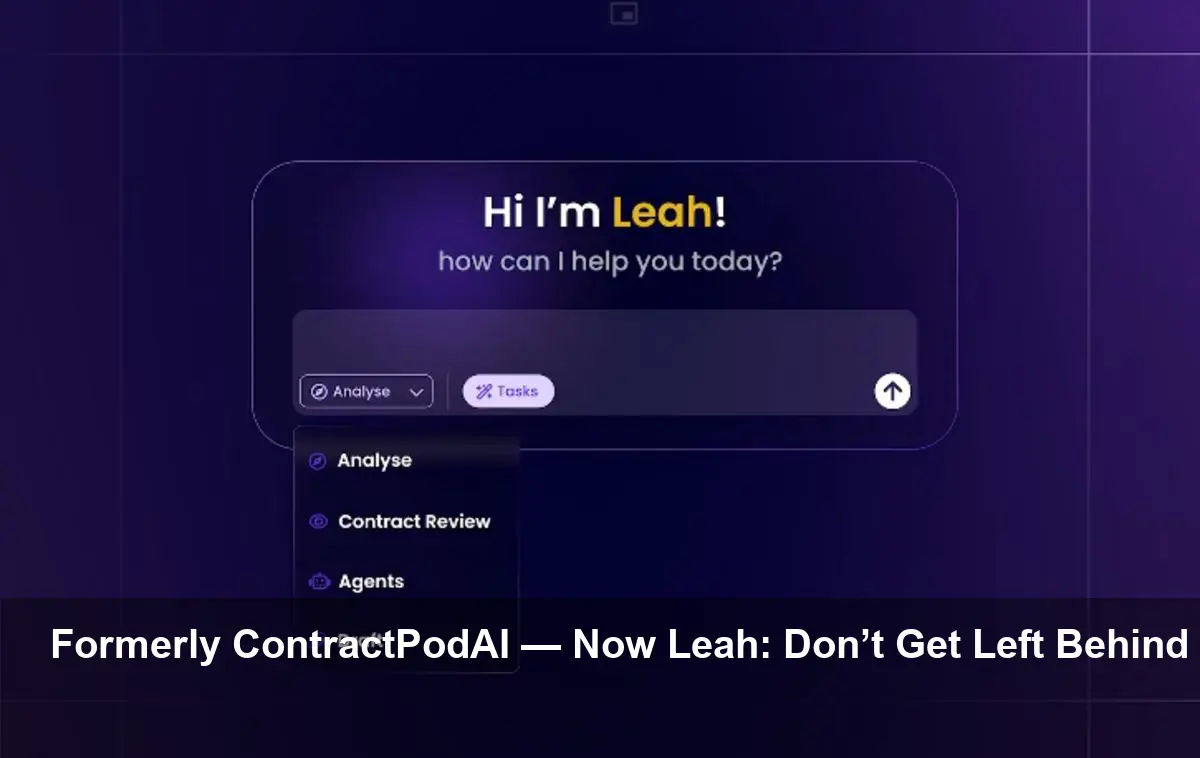
ContractPodAI becomes Leah to broaden agentic automation beyond CLM
- ContractPodAI has rebranded as Leah to signal a strategic shift beyond contract lifecycle management (CLM).
- The company says it will push into “agentic automation,” aiming to deliver autonomous, workflow-driven capabilities across enterprise functions.
- The rebrand reflects a move to position the company for broader legaltech and enterprise automation use cases, not just contracts.
- Market implications: customers and competitors should expect expanded product scope, deeper integrations, and new go-to-market messaging.
What changed — and why it matters
ContractPodAI, a known name in contract lifecycle management, has adopted a new corporate identity: Leah. The rebrand signals a deliberate pivot from a product image tied primarily to contracts toward an ambition to deliver “agentic automation” — autonomous, AI-driven agents that can perform tasks across workflows and systems without constant human direction.
From CLM to cross-functional automation
Historically, ContractPodAI’s identity was centered on legal operations and contract management. As Leah, the company is making clear it intends to take the core automation, AI and workflow capabilities it developed for CLM and apply them more widely across enterprise functions — legal, procurement, sales operations, and beyond. That broader scope aims to turn point solutions into platform-level offerings that can coordinate tasks end-to-end.
What is agentic automation?
Agentic automation describes systems that can act with a degree of autonomy: creating, prioritizing and executing tasks or sub-workflows, often across multiple applications and data sources. For enterprises this can mean fewer manual handoffs, faster cycle times and more consistent outcomes — particularly for repetitive, rules-driven processes.
Implications for customers and the market
For Leah’s existing customers, the rebrand suggests a roadmap toward broader integration and capabilities that extend beyond contract drafting, negotiation and storage. Enterprises that adopted ContractPodAI for CLM should expect product messaging and feature development to emphasize cross-department orchestration, configurable agents and integration with enterprise systems.
Competitive and strategic context
Rebranding to Leah positions the company against other legaltech and automation vendors expanding into agentic or autonomous capabilities. It’s a recognition that the market increasingly rewards platforms that deliver end-to-end automation, not just specialty modules. Competitors and buyers will be watching product announcements and partnership activity closely to gauge how fast Leah can execute on this broader vision.
What to watch next
Key signals to follow include Leah’s product roadmap, new integration partnerships, early enterprise deployments outside traditional CLM, and any updates on pricing or packaging that reflect platform-level ambitions. If Leah can successfully translate CLM expertise into reliable agentic automation across business functions, it could reshape expectations for how AI is used in enterprise operations.
No embedded social media posts or YouTube videos were included in the source material.
Image Referance: https://siliconangle.com/2026/01/05/contractpodai-rebrands-leah-expand-agentic-automation-beyond-contract-lifecycle-management/