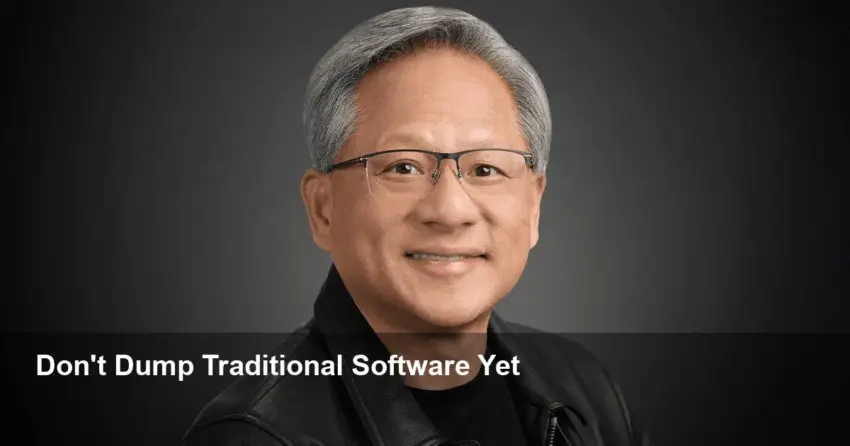
- Jensen Huang argues AI will not make traditional software tools obsolete.
- His stance counters fears of widespread automation-driven replacement in the tech market.
- The comments arrive as companies face rapid change and uncertainty about AI’s role.
- Businesses should treat AI as an augmentation layer, focus on governance and upskilling.
What Jensen Huang said
NVIDIA CEO Jensen Huang has pushed back against growing fears that artificial intelligence will render existing software tools and developer workflows obsolete. While acknowledging the rapid pace of AI development and its disruptive potential, Huang framed AI as an augmentation technology that enhances — rather than entirely replaces — established software ecosystems.
The remarks are notable because they come from the leader of a company whose hardware and software stacks are central to AI infrastructure. Huang’s view suggests confidence that traditional tools, integrations and the developers who maintain them will remain important as AI scales across industries.
Why this matters
Market anxiety around AI stems from two related concerns: automation displacing jobs and new AI systems making legacy tools irrelevant overnight. Huang’s perspective addresses both by emphasizing continuity. If AI is integrated as a complementary layer, enterprises and vendors can preserve existing investments in software while adopting AI capabilities.
For software vendors, this reduces pressure to throw out platforms and start from scratch. For enterprise IT teams, it underscores the need to manage AI adoption carefully rather than pursue rushed, wholesale replacements that create security, compliance and integration headaches.
Implications and reactions
Huang’s stance is likely to reassure stakeholders who fear sudden disruption. Investors tracking AI-driven shifts may see this as a signal that the transition will be evolutionary, not instantaneous — that a market for tooling, connectors and governance will persist. Developers and product teams should take this as a cue to focus on how AI can be embedded into existing workflows to boost productivity rather than attempting to replace well-established processes.
At the same time, the CTOs and product managers who move slowly risk falling behind if they treat AI as optional. The balance is subtle: don’t discard proven systems, but do experiment with AI-powered features that deliver measurable gains.
Practical next steps for businesses
- View AI as an augmentation layer: pilot AI features inside current tools before replacing them.
- Invest in governance: ensure outputs are auditable, secure and compliant with policies.
- Upskill teams: train developers and analysts to validate AI outputs and build safe integrations.
- Measure impact: prefer targeted pilots with clear KPIs over broad, risky rewrites.
Bottom line
Jensen Huang’s comments temper the most extreme predictions about AI wiping out traditional software tools. The message for leaders is pragmatic: treat AI as powerful augmentation, not an automatic trigger to abandon existing systems. That approach reduces risk, preserves value from past investments and creates a clearer path for steady, measurable AI adoption.
Image Referance: https://technologymagazine.com/news/nvidia-ceo-defends-software-tools-amid-ai-automation-fears