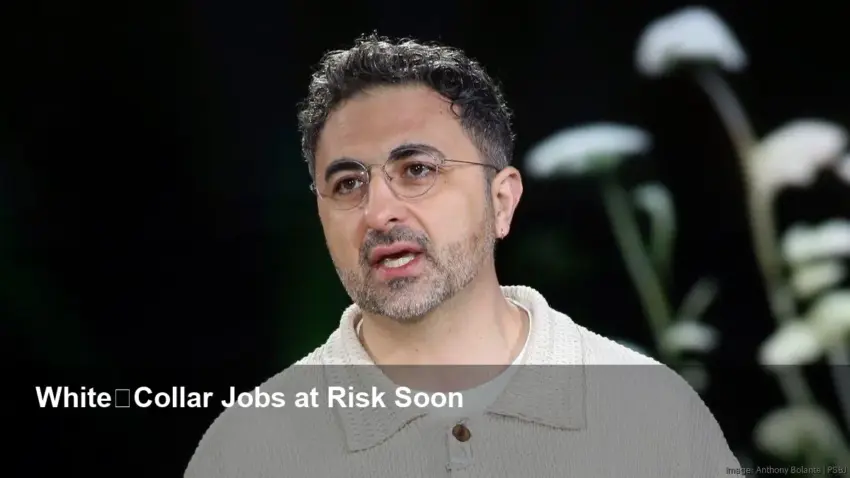
- Microsoft AI chief Mustafa Suleyman predicts many white‑collar tasks could be automated within 18 months.
- He attributes the timeline to rapid advances in software engineering and AI‑assisted coding tools.
- The shift could boost productivity but raise urgent questions about jobs, reskilling and corporate planning.
What Suleyman predicted
Mustafa Suleyman, who leads AI efforts at Microsoft, told reporters that rapid progress in software engineering and AI‑assisted coding tools makes it likely that a broad swath of white‑collar work will be automated within roughly 18 months. The forecast centers on improvements in how software is developed and how AI systems can generate, review and integrate code—capabilities that, Suleyman said, accelerate the pace at which routine and semi‑routine office tasks can be handled by machines.
Why this matters now
The prediction compresses a timeline many organizations expected to play out over several years into a matter of months. For businesses, that creates both opportunity and risk. On the opportunity side, faster automation can drive productivity gains, speed product development and lower costs for repetitive tasks. On the risk side, companies will need to reconsider workforce plans, hiring timelines and compliance frameworks while facing potential disruption to existing roles.
How software engineering advances drive change
Suleyman points to rapid advances in software engineering—improvements in developer tools, CI/CD pipelines, automated testing and, crucially, AI‑assisted coding systems that can write and refactor code. These tools are lowering the barrier to building and deploying automation, enabling organizations to convert manual processes into software solutions much faster than before.
Impacts for workers and employers
For employees, the immediate implication is a need to reassess which skills remain essential. Roles that rely heavily on repeatable data entry, routine analysis, or standard code maintenance are most exposed. For employers, the need is practical: identify which processes can be automated safely, plan transitions, invest in retraining, and design oversight to ensure AI outputs meet quality and ethical standards.
What leaders should do now
Business leaders should treat the prediction as a call to action rather than a distant trend. Short steps include auditing workflows to find quick automation wins, launching pilot projects with clear metrics, and creating reskilling pathways for affected staff. Equally important is establishing governance—clear accountability, testing and human review—so automation scales without causing errors or compliance failures.
Outlook
Suleyman’s 18‑month horizon highlights how quickly AI tools are moving from experimental to operational. Companies that adapt—by prioritizing responsible deployment, retraining workers and adjusting strategy—may capture outsized benefits. Those that delay risk being outpaced as competitors deploy automation to reduce costs and accelerate development cycles.
While timelines for change always contain uncertainty, Suleyman’s forecast underscores one clear takeaway: organizations should accelerate planning for automation now, not later.
Image Referance: https://www.bizjournals.com/seattle/news/2026/02/12/microsoft-ceo-ai-mustafa-suleyman-automation.html