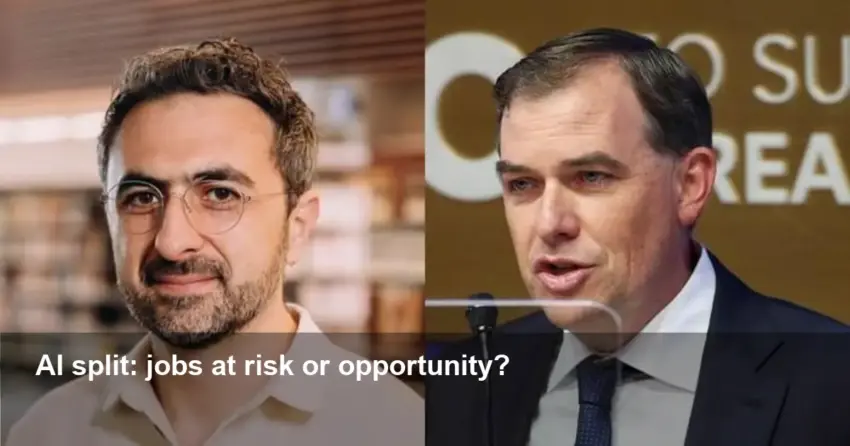
- Microsoft CEO warned of widespread automation in white-collar jobs.
- Amazon Web Services CEO pushed back, disputing the scale and timing of job losses.
- The disagreement highlights deep uncertainty about how AI will reshape the software industry.
- Developers, managers and policymakers now face urgent choices on skills, hiring and regulation.
Two tech leaders, very different forecasts
The CEOs of two of the world’s biggest cloud and software companies publicly diverged over AI’s effect on the software industry. The Microsoft CEO warned that AI could lead to widespread automation across white‑collar roles, while the Amazon Web Services CEO disagreed on how quickly and how broadly that will happen.
Why the split matters
This isn’t a narrow debate about product strategy: it’s a debate about jobs, hiring and corporate investment. When leaders at the largest enterprise cloud providers disagree, customers, investors and employees pay attention. Companies building software and teams that depend on developer talent must decide whether to accelerate automation, retrain staff, or delay large‑scale changes.
What each perspective implies
Microsoft CEO’s warning
The Microsoft CEO’s comments underscore a worst‑case scenario for many white‑collar roles: rapid adoption of AI tools that automate routine engineering, testing, documentation and operational tasks. If that outcome materializes, businesses could see headcount reductions in some functions, compressed hiring for entry‑level roles, and faster shifts toward roles requiring oversight, governance and model management.
AWS CEO’s counterpoint
The Amazon Web Services CEO pushed back on the immediacy or universality of such job losses. From this viewpoint, AI will be a powerful productivity multiplier that changes job content rather than erasing whole professions overnight. That suggests a slower transition with opportunities for reskilling and new kinds of developer work focused on designing, integrating and securing AI systems.
Impacts for developers and businesses
Regardless of which forecast proves closest to reality, the split signals practical steps organizations should consider now:
- Reassess hiring — focus on adaptable skills like systems thinking, model assessment and AI governance.
- Invest in reskilling and internal mobility to retain institutional knowledge as tooling changes.
- Treat AI rollouts as product changes that require testing, monitoring and clear ownership.
Policy and industry reaction
The disagreement also feeds into broader public debates about labor markets and regulation. Policymakers monitoring AI’s effect on employment will use such high‑profile splits to shape workforce programs, education funding and potentially employer reporting requirements.
What to watch next
Watch company roadmaps, enterprise procurement decisions and hiring trends over the coming months. If enterprises accelerate AI adoption at scale, the Microsoft CEO’s warning could translate into faster structural change. If adoption proves more incremental, the AWS perspective—AI as augmentation—may dominate.
For software workers and leaders, the takeaway is practical: prepare for change, prioritize skills that AI complements, and expect continued debate at the highest levels of the industry.
Image Referance: https://www.chosun.com/english/industry-en/2026/02/13/UZFQKOIXJFE7HNRZAYO3YSWUBM/