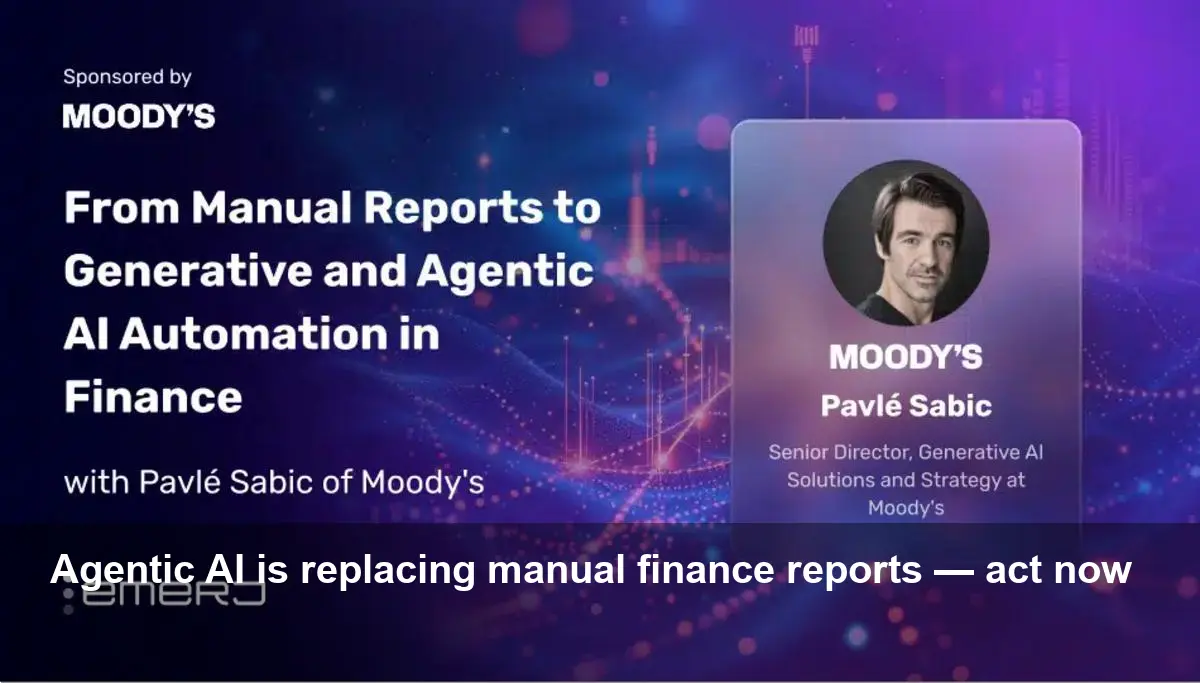
Moody’s on Agentic AI: End of Manual Finance Reports
- Generative and agentic AI are shifting finance teams away from manual report creation toward automated, decision-capable systems, says Pavlé Sabic of Moody’s.
- Early deployments speed reporting, improve scenario analysis and reduce human error—but create new risks around data quality, explainability and regulatory compliance.
- Moody’s recommends narrow pilots, strong governance, human-in-the-loop oversight and upskilling to capture benefits while containing model risk.
The transition: from manual reporting to agentic automation
According to Pavlé Sabic of Moody’s, high-stakes finance decisions are becoming too complex for traditional automation. Firms are moving from template-driven, manually compiled reports to generative AI that writes narratives and agentic systems that can take actions across workflows. These systems can draft credit assessments, run scenario simulations, and trigger downstream processes—dramatically reducing latency between insight and action.
Concrete use-cases gaining traction
Sabic highlights several practical applications where generative and agentic AI are already proving valuable:
- Credit and risk reporting: automatically producing first-draft narratives and summaries for analysts to review.
- Scenario analysis: running and comparing many stress scenarios faster than manual pipelines allow.
- Workflow orchestration: agentic tools that gather inputs, call models, and file outputs into regulatory and internal systems.
- Operational automation: reducing repetitive tasks so analysts focus on judgment and exceptions.
Risks and governance: why speed creates new hazards
While gains are real, Sabic stresses the rise of new risks. Model errors, data fragmentation, and opaque model reasoning can create systemic exposure if not managed. Regulators and internal risk teams demand explainability, audit trails, and controls—requirements that are sometimes at odds with off-the-shelf generative models. Without robust governance, organisations risk amplified mistakes, regulatory fines, and reputational harm.
Key governance priorities
- Data quality and lineage: ensure inputs are accurate and traceable.
- Human-in-the-loop checkpoints: maintain oversight on judgments and exceptions.
- Model monitoring and versioning: detect drift and control deployments.
- Regulatory alignment: map AI outputs to compliance needs and reporting standards.
Practical steps Moody’s recommends
Moody’s advised starting with focused pilots on narrowly defined tasks, building custodial datasets, and layering guardrails—rather than broad, uncontrolled rollouts. Upskilling staff to collaborate with AI, investing in explainability tools, and integrating AI workflows with existing systems are essential. These steps reduce operational surprises and accelerate measurable value.
Outlook: augmentation, not wholesale replacement
Sabic’s outlook is pragmatic: agentic AI will augment finance professionals by automating routine synthesis and enabling faster decision cycles, but human expertise remains critical for oversight, interpretation and final judgment. Firms that move now—carefully and governed—stand to gain speed and competitive advantage; those that delay risk falling behind as these tools mature.
Note: This coverage summarizes an interview with Pavlé Sabic of Moody’s and is aligned with sponsored-content disclosures.
Image Referance: https://emerj.com/from-manual-reports-to-generative-and-agentic-ai-automation-in-finance-with-pavle-sabic-of-moodys/