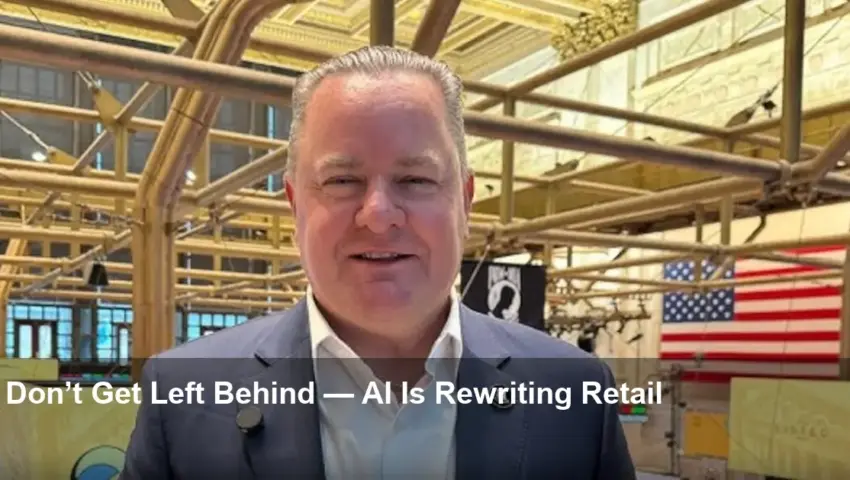
- Leaders from AWS, Celonis and other vendors are collaborating to scale AI-driven retail automation while tackling latency, trust and ROI.
- Key technical fixes include edge compute, observability and event-driven architectures to cut latency and improve customer experience.
- Governance, measurement and phased pilots are essential to build trust and demonstrate ROI at scale.
- Retailers that delay risk falling behind competitors already piloting production-ready AI automation.
Retail automation meets its AI moment — and new hard questions
Retail automation has entered an AI era. Major platform and process vendors — including AWS and Celonis — are working across the aisle with retailers and technology partners to move beyond pilots and address the operational realities that stand between prototypes and production-grade, revenue-driving systems.
Latency: the invisible conversion killer
One of the clearest technical obstacles is latency. Shoppers expect instant responses, and AI-driven automation that runs only in centralized clouds can introduce delays that harm conversion and customer satisfaction. Industry leaders are prioritizing edge compute, event-driven architectures and caching strategies to keep inference and decisioning close to where shoppers interact with systems.
Practical steps for teams
- Adopt hybrid cloud-edge deployments for real-time inference.
- Implement observability focused on request-to-response timing across services.
- Use asynchronous workflows for non-critical tasks to avoid blocking the customer experience.
Trust and governance: more than compliance
Trust in AI outputs matters both for customers and for internal stakeholders who must rely on automated decisions. Retailers and platform partners are hardening model governance, explainability and human-in-the-loop checkpoints so that automation improves outcomes without introducing unacceptable risk.
Checklist to build trust
- Model versioning and audit trails for every decision pipeline.
- Explainability tools that surface why a recommendation or automated action occurred.
- Operational runbooks that define when humans should override automation.
Proving ROI: from pilots to scalable value
Demonstrating clear, measurable returns is the final hurdle. Leaders recommend structured pilot programs tied to explicit KPIs — conversion lift, labor cost reduction, shrink reduction, or fulfillment throughput — and roadmap plans that show how incremental gains compound as automation scales.
Best practices
- Define KPIs before technology selection and measure continuously.
- Start with high-impact, low-risk use cases to build momentum and social proof inside the organization.
- Plan for observability and attribution so you can link AI actions directly to business outcomes.
Collaboration wins: vendors, retailers and integrators
Retailers that succeed are those that treat automation as a systems problem, not a single-vendor product. Cross-industry collaboration — blending platform scale from cloud providers, process mining and orchestration from tooling vendors, and retail domain expertise — is emerging as the fastest path to production-grade deployments.
Bottom line
AI has the potential to reshape retail automation, but latency, trust and ROI remain real challenges. Organizations that adopt hybrid architectures, rigorous governance, and KPI-driven pilots will move fastest. Those that delay risk losing competitive ground as early adopters convert experimentation into measurable business value.
Image Referance: https://siliconangle.com/2026/01/16/retail-automation-meets-ai-era-airetailtrailblazers/