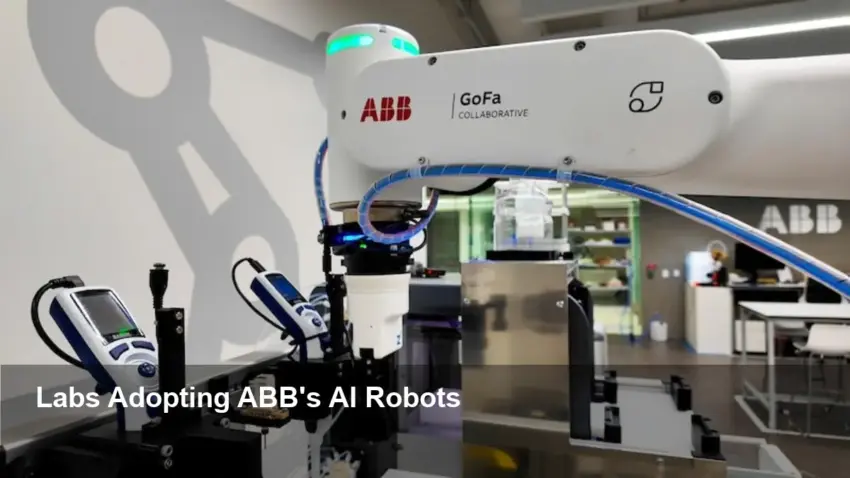
- ABB Robotics showcased AI-powered, interoperable lab automation workflows at SLAS 2026.
- The company emphasized scalable robotic systems designed to increase throughput and reproducibility.
- The demonstration highlighted interoperable architectures intended to connect robots, instruments and data flows.
ABB’s showcase at SLAS 2026
At SLAS 2026, ABB Robotics presented a focused demonstration of AI-enabled, interoperable lab automation workflows. The company highlighted systems built for scale, designed to help laboratories increase sample throughput while improving reproducibility across experiments. The announcement positions ABB squarely within a broader industry shift toward smarter, connected automation in life-science and clinical labs.
What ABB emphasized
ABB’s presentation centered on three practical priorities: automation that is AI-driven, systems that interoperate with other lab instruments and software, and scalable hardware architectures that can grow with a lab’s needs. While specifics about product models or customer deployments were not detailed in the short announcement, the core message was clear: combine AI and open connectivity to reduce manual steps, speed workflows and make results more consistent.
Why this matters to labs
Laboratories face mounting pressure to process higher volumes of samples faster and with reliable, repeatable results. Interoperable automation can reduce handoffs and manual errors, while AI can optimize scheduling, error detection and process control. Together, those capabilities can help labs increase throughput without sacrificing data quality — and reduce the operational risk of bottlenecks or inconsistent protocols.
Industry context and implications
ABB’s SLAS 2026 showcase reflects wider trends: suppliers are moving from single-task robots to integrated, software-first automation platforms. For lab managers and decision-makers, the risk is clear — organizations that delay adopting interoperable, AI-enabled tooling may fall behind peers that can run experiments faster and reproduce results more reliably.
Next steps for adopters
Labs considering modernization should evaluate interoperability (how easily a robot connects to instruments and data systems), AI capabilities (what problems the software actually solves) and scalability (can the hardware expand as throughput needs grow). Vendors such as ABB aim to simplify these decision paths by offering demonstrable workflows that stitch together robots, instruments and analytics.
Bottom line
ABB’s presence at SLAS 2026 reinforced a simple takeaway: the future of lab automation pairs AI with open, interoperable robotics to deliver higher throughput and better reproducibility. For labs and institutions, the strategic choice is whether to adopt these capabilities now — or risk falling behind competitors that do.
Image Referance: https://roboticsandautomationnews.com/2026/02/09/abb-showcases-the-future-of-lab-automation-at-slas-2026/98782/