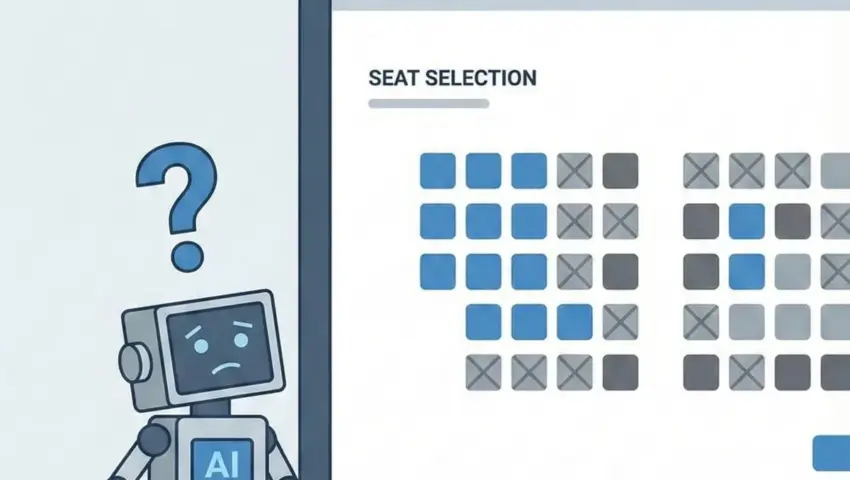
- Browser-based AI agents can mimic clicks, but they can’t legally complete flight bookings yet.
- Terms of service, payment rules and anti-fraud systems—not just technical limits—are the main barriers.
- Workarounds require partnerships, official APIs or human-in-the-loop flows; unauthorized automation risks account bans and legal liability.
- The future points to sanctioned agent APIs and tokenized delegation — act now to avoid building on fragile workarounds.
Why your AI agent can’t book flights yet
Capabilities vs. control: a decisive gap
Modern browser-based AI agents are technically capable of filling forms, navigating multi-step flows and interacting with complicated UIs. That makes it tempting to try to automate flight shopping and booking end-to-end. But the problem today is not whether an agent can click the right buttons — it’s whether platforms will let it, and whether the law, payment systems and platform policies allow it to act autonomously.
Terms of Service and explicit bans
Many travel sites and aggregators explicitly forbid automated access or transactions in their terms of service. Violating these terms can lead to account suspension, IP blocks, or legal action. For commercial implementations, relying on scraping or simulated browser automation without permission is fragile and exposes operators to enforcement.
Payments, compliance and liability
Booking a flight involves handling payment card data, refunds and chargebacks. Payment networks and processors require PCI-DSS compliance and strict identity controls. If an AI agent acts as an autonomous buyer, who is legally responsible for a fraudulent charge or an incorrect booking? That unresolved liability makes payment processors wary of enabling fully automated purchases.
Anti-fraud, CAPTCHAs and bot management
Flight sellers deploy anti-bot measures — CAPTCHAs, behavioral detection and third-party bot mitigation (Cloudflare, PerimeterX, Akamai) — precisely to stop automated purchases (often used by scalpers). These systems can and do block headless browsers and scripted agents, making reliability low for unauthorized automation.
Why simple technical fixes won’t solve it
Developers often attempt headless evasion, human-in-the-loop workarounds, or rotating proxies. Those approaches can temporarily bypass defenses but they don’t change the contractual and regulatory realities. You may succeed at scale for a short time, but you risk account bans, blacklisting, and legal exposure — outcomes that undercut any business built on such tactics.
Realistic paths forward
1. Use official APIs and partnerships
Partnering with travel providers or using sanctioned booking APIs is the safest route. APIs are designed for automation and come with agreed terms, service-level guarantees, and proper handling of payments and identity.
2. Human-in-the-loop and delegated consent
Hybrid flows where an agent prepares options and a human confirms the final purchase reduce legal exposure and keep compliance intact.
3. Industry standards and regulated agent tokens
Longer term, expect solutions that let users delegate limited authority to trusted agents via standardized tokens or OAuth-like consent models — a controlled way to let agents act without violating rules.
Bottom line
Autonomous flight booking is not just a technical challenge — it’s a legal, financial and platform-control problem. If you’re building or experimenting with booking agents, prioritize sanctioned APIs, partnerships, and human-approved flows instead of brittle hacks. The window for doing this right is open now; ignore it and you’ll face enforcement or a failed product.
Image Referance: https://ppc.land/why-your-ai-agent-cant-book-flights-yet/