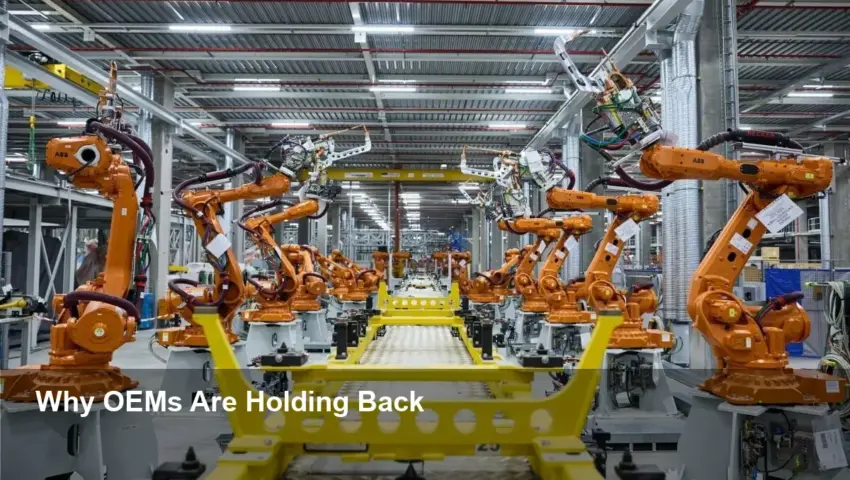
- AI-assisted robotics, digital twins and condition monitoring are changing automotive automation.
- Major barriers remain: cost, safety, process variability and unclear ROI limit mass deployment.
- MTC’s Mike Wilson says OEMs are pursuing pilots where benefits are proven, not blanket rollouts.
Automation advances meet practical limits
Automotive factories are testing a new generation of automation tools: AI-assisted robots that adapt on the fly, digital twins that model entire production lines, and condition‑monitoring systems that flag failures before they happen. Together these technologies promise higher uptime, faster changeovers and less manual rework.
But progress is uneven. MTC (Manufacturing Technology Centre) engineering lead Mike Wilson tells industry audiences that despite the promise, cost, safety, variability and return on investment (ROI) still define what OEMs can deploy at scale.
Why OEMs are cautious
1. Cost and capital risk
Advanced robotics, sensors and the computing infrastructure for digital twins require significant upfront investment. For high‑volume lines the payback can be attractive; for lower‑volume or highly variable assemblies the capital risk rises, slowing rollouts.
2. Safety and certification
Adding AI into motion control changes risk profiles. New control strategies and adaptive behaviors need rigorous validation and, often, extra guarding or certification. OEMs must balance potential productivity gains against the cost and time needed to demonstrate safe, repeatable operation.
3. Process variability
Many vehicle assembly tasks still face part variation, unpredictable human interactions and complex fixturing. AI and digital twins can model and compensate for some variability, but where variability is high the systems either become costly to tune or deliver inconsistent savings.
4. Unclear or long ROI
Unless a use case delivers measurable improvements in cycle time, quality or uptime, procurement teams are reluctant to replace proven systems. OEMs are prioritizing deployments where ROI is clear — such as condition monitoring on critical tooling or AI vision for high‑volume inspection — and delaying riskier, more speculative applications.
How OEMs are deploying technology today
According to Mike Wilson, the pragmatic approach is to run tightly scoped pilots that prove the value case, then scale incrementally. Typical early deployments include condition monitoring to reduce unplanned stops, digital twins for process optimisation, and AI‑assisted cobots in low‑risk, repeatable tasks.
What this means for suppliers and factories
Suppliers should focus on turnkey solutions with clear metrics, simplified integration and demonstrable safety cases. For factories, the pragmatic path is to identify high‑frequency pain points with short payback windows and build human oversight into automated systems to maintain flexibility.
Outlook: measured progress, not instant transformation
AI, digital twins and condition monitoring are reshaping possibilities in automotive manufacturing. But as Mike Wilson notes, widespread scale depends on solving practical constraints. Expect steady, selective adoption where the economics and safety case are proven — rather than blanket automation across every line.
Image Referance: https://www.automotivemanufacturingsolutions.com/automation/automotive-automation-ai-digital-twins-and-the-real-limits-of-scale/2594707