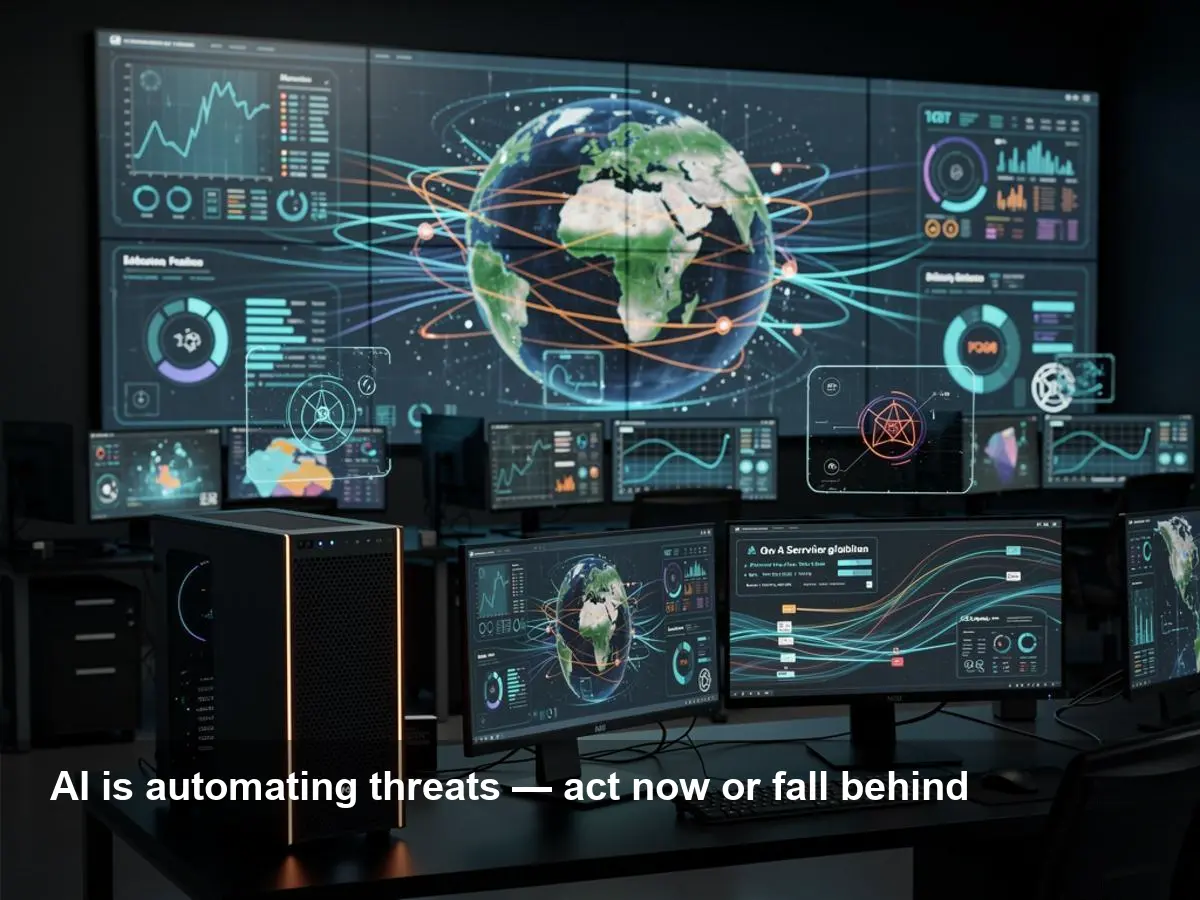
- AI is increasingly automating routine threat detection and response across SOCs in 2025.
- Early adopters report faster triage times, reduced analyst burnout, and measurable efficiency gains.
- Experts warn reliance on AI without human oversight risks missed context and adversarial tricks.
- Widespread adoption is creating a competitive divide: organizations that delay risk slower response and higher costs.
AI Transforms SOCs in 2025: Automation Reduces Workload, Raises Stakes
What’s changing now
In 2025, Security Operations Centers (SOCs) are racing to integrate advanced AI into everyday workflows. Machine learning models and generative tools are automating repetitive tasks — from alert triage to malware classification — freeing analysts for higher-value investigation. The result: faster detection, shorter mean time to respond (MTTR), and lower operational fatigue among security teams.
Where the gains come from
Automation tools are streamlining three core SOC functions: signal enrichment, runbook execution, and incident prioritization. AI can correlate telemetry across endpoints and cloud logs, propose playbooks, and even execute containment steps under human approval. Early deployments show significant reductions in false positives and hours spent on low-signal alerts.
Real-world impact
Security leaders report improved analyst retention and morale as mundane alert queues shrink. Organizations that combine AI-driven automation with clear escalation policies see triage time drop by as much as 40–60% in pilot programs. That translates into quicker mitigation and lower business disruption.
Risks and limitations
Despite clear benefits, experts emphasize caution. Overreliance on automated decision-making can create blind spots: contextual nuances, chained attack techniques, and adversarial inputs can still fool models. Threat actors are already experimenting with techniques to evade AI detection, forcing security teams to maintain human oversight and continuous model validation.
Human + machine is the safe bet
Best-practice SOCs are adopting a hybrid approach: let AI handle scale and consistency, but keep humans in the loop for hypothesis-driven investigations and policy tuning. Ongoing training data curation, red-team testing, and explainability tools are crucial to avoid automation brittleness.
Industry adoption and competitive pressure
Adoption rates are accelerating as vendors embed AI across SIEM, XDR, SOAR, and cloud security platforms. This momentum creates a competitive pressure on organizations that delay adoption — a classic FOMO scenario. Companies that adopt thoughtfully gain speed and resilience; those that wait risk higher incident costs and talent attrition.
Takeaway
AI is reshaping SOC operations in 2025 by automating routine tasks and reducing burnout. The technology delivers clear efficiency and retention gains, but only when implemented with human governance and continuous validation. The immediate decision for security leaders is not whether to adopt AI, but how to do so safely and strategically.
Image Referance: https://www.webpronews.com/ai-transforms-socs-in-2025-automating-threats-cutting-burnout/