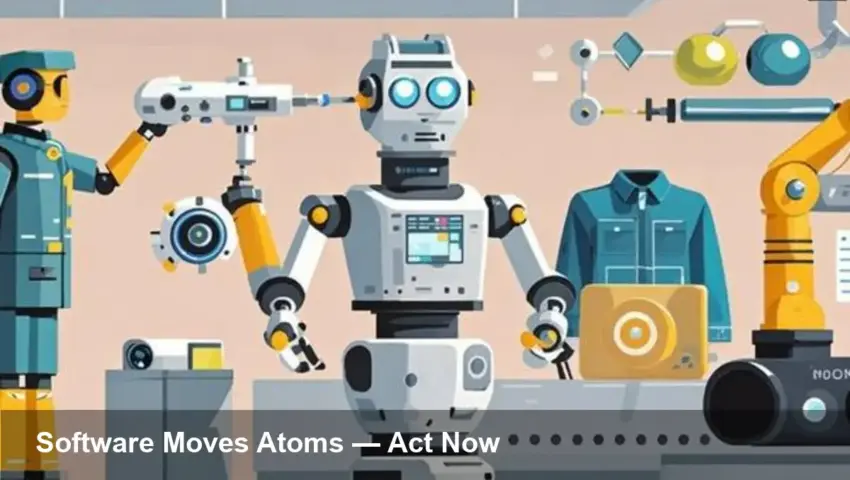
- Software is increasingly the instruction layer that makes physical things — literally moving atoms — through automation, 3D printing and molecular tools.
- Today’s tools (additive manufacturing, robotics, programmable materials, synthetic biology) turn code into matter; by 2026 change may accelerate.
- The shift promises faster product cycles, on-demand manufacturing and medical advances — but also supply risks, safety gaps and job disruption.
- Watch regulation, standards, and which labs or startups achieve scalable, repeatable control — these will determine who benefits.
What “software moves atoms” actually means
Software traditionally controls screens and data. The phrase “software moves atoms” describes a more literal function: code that tells machines or molecular systems how to place, alter or assemble physical building blocks. That can be as familiar as a 3D printer laying down plastic layers, or as exotic as synthetic biology arranging molecules to form new materials.
How it’s already happening
- Additive manufacturing and robotics: CNC machines, industrial robots, and multi‑material 3D printers translate digital designs into physical parts with increasing speed and precision.
- Programmable materials and “smart” assemblies: Materials that change shape or properties in response to signals are blurring the line between software and matter.
- Molecular and biological tools: Advances in molecular machines and DNA nanotechnology mean researchers can program actions on the nanoscale; these approaches are early but growing.
Each of these fields connects code to a physical effect. Together, they form a pipeline where software becomes the main catalyst for material change.
Why this matters — benefits and opportunities
When software reliably controls matter, product development compresses. Personalization and local, on‑demand manufacturing could reduce inventory and speed innovation. In healthcare, programmable manufacturing may enable bespoke implants, tailored drug delivery systems, or rapid vaccine production workflows.
For businesses, moving from design files to finished goods with fewer manual steps promises lower unit costs and faster iteration — which creates a powerful competitive edge. That’s the FOMO: organizations that adopt reliable digital‑to‑atomic workflows early can capture outsized advantages.
Risks, unknowns and the downside
Negativity bias is appropriate here: precision at scale brings new failure modes. Faulty code could produce defective parts with safety consequences. Democratizing powerful tools increases misuse risk if governance lags. There’s also economic disruption for roles tied to traditional manufacturing and logistics.
Public health, cybersecurity and export controls will intersect with these technologies. Expect debates over standards, certification and liability as software increasingly dictates physical outcomes.
What to watch toward 2026
- Standardization and certification efforts for software-driven manufacturing.
- Demonstrations that scale: repeatable, high-throughput workflows that move beyond prototypes.
- Cross-disciplinary partnerships between software teams, materials scientists and regulators.
- Investment and hiring trends: which sectors and regions are building capacity.
Bottom line
The idea behind “Imagine 2026: The Second Part” is not science fiction but an accelerating reality: software is becoming the action engine for physical systems. The rewards could be significant, but so are the risks. Paying attention now to standards, safety and scalable demonstrations will tell us who really benefits and who gets left behind.
Image Referance: https://eu.36kr.com/en/p/3625185815086337