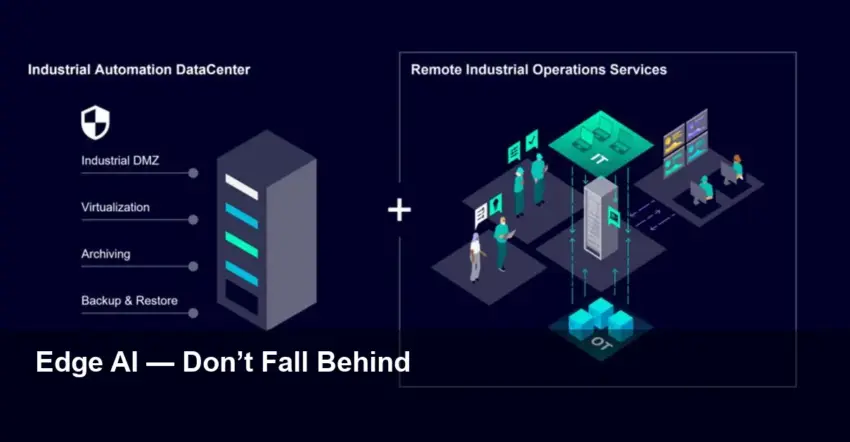
- Siemens has updated its Industrial Automation DataCenter to be AI-ready, enabling accelerated AI computing at the edge for production environments.
- The change targets real-time, on-premise AI use cases in manufacturing, aiming to reduce latency and keep sensitive data local.
- Siemens positions the DataCenter to bridge OT and AI workloads, helping manufacturers deploy models in live production more safely and efficiently.
What Siemens announced
Siemens announced that its Industrial Automation DataCenter is now “AI-ready,” a move intended to bring accelerated AI computing power closer to manufacturing operations. According to Siemens, the upgrade is focused on running powerful AI applications directly in production environments — at the edge rather than only in centralized cloud data centers.
The announcement frames the DataCenter update as a way to support latency-sensitive inference, faster decision-making on the shop floor, and stricter control over industrial data. Siemens describes the change as an enabling step for customers to deploy AI models where they operate, while keeping critical operational technology (OT) systems secure and compliant.
Why this matters for manufacturers
Making edge environments AI-ready addresses several growing pain points for industrial organizations:
- Reduced latency: Running inference closer to machines cuts the round-trip delays that can undermine real-time control or quality-inspection tasks.
- Data sovereignty and security: On-premise or edge AI limits the need to send sensitive production data to external clouds, easing compliance and risk.
- Operational continuity: Localized AI inference can keep analytic and control functions running even if connectivity to central systems is degraded.
For manufacturers already experimenting with computer vision, predictive maintenance, or real-time optimization, an AI-ready edge can make pilots transition to full production more practical. Siemens frames the DataCenter update as a bridge between traditional automation capabilities and modern AI workloads.
How this fits into real-world use cases
Industry applications that stand to benefit include visual quality inspection, anomaly detection on equipment, adaptive process control, and localized model serving for robots and autonomous vehicles. By enabling accelerated compute at the edge, the platform aims to support workloads that require both speed and reliability.
Companies considering adoption should evaluate their existing OT/IT integration, model lifecycle tooling, and how they will manage updates and governance at distributed sites. Siemens’ approach is meant to simplify those steps, though individual integration work and testing will still be required.
What to expect next
Siemens’ AI-ready positioning signals a broader industry shift toward bringing advanced AI capabilities into production operations rather than keeping them confined to research or cloud environments. For manufacturers, the practical next steps are pilot deployments, validating models under real production loads, and planning governance for distributed AI.
Siemens’ update is a reminder that the competitive edge in manufacturing increasingly depends on how quickly organizations can operationalize AI — and that organizations that delay may face performance, quality, or compliance risks as competitors move faster.
Image Referance: https://press.siemens.com/global/en/pressrelease/ai-ready-edge-siemens-industrial-automation-datacenter-accelerated-ai-computing-power