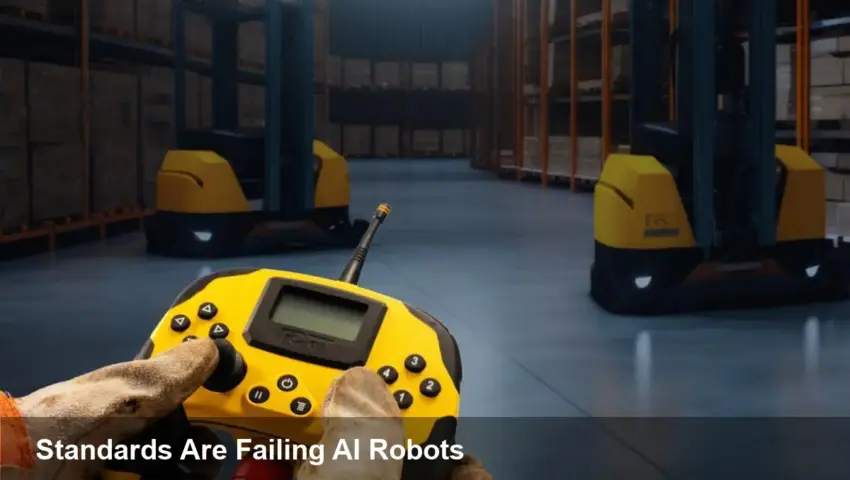
• Traditional safety standards were designed for fixed, predictable machines — they don’t fit adaptive, learning robots.
• AI-driven systems change behavior at runtime, creating shifting hazards that static rules miss.
• Manufacturers need context-aware, proactive safety: continuous monitoring, simulation-based validation and human oversight.
• Evolving standards, industry collaboration and new certification approaches are required to reduce risk in modern factories.
Why current standards fall short
Most long-standing industrial safety standards assume machines behave in repeatable, well-defined ways. Guarding, fixed interlocks, and predefined safe states were adequate for conveyor belts and fixed robots. AI-driven and agile robotic systems — collaborative robots (cobots), adaptive vision-guided arms and learning-enabled controllers — no longer fit that model because they can change decisions based on new data or updated models. That creates safety gaps a static checklist cannot reliably close.
What makes AI-driven robots different
AI-enabled systems introduce uncertainty in two ways: behavior can vary with changing inputs, and models can be updated in deployment. This undermines assumptions behind deterministic hazard analyses. A robot that adapts to new part geometries or optimizes its path to improve throughput may take actions engineers didn’t predict during design-time testing. The result: new, context-dependent hazards that legacy standards were not written to address.
Practical steps manufacturers should take
Safety teams must move from static compliance to continuous assurance. Key practices include:
- Context-aware risk assessment — evaluate hazards not just by design, but by operational context (task, environment, human proximity, data drift).
- Runtime monitoring and anomaly detection — instrument systems to detect behavior outside expected envelopes and trigger safe modes automatically.
- Simulation and digital twins for validation — use realistic scenarios to test how models behave under edge cases before deploying updates.
- Human-in-the-loop controls and explainability — ensure operators can intervene and understand why a system made a decision.
- Versioned certification and change control — validate and re-certify after significant model or software updates rather than assuming previous approval still applies.
Why this matters now
As factories push for agility and higher automation levels, the pace of software and model changes is increasing. Without updated safety approaches, manufacturers risk production stoppages, regulatory scrutiny and — most importantly — harm to workers. The gap between how robots are certified today and how they actually operate in modern, data-driven environments is widening.
Moving standards forward
Closing the gap will require standards bodies, OEMs and end-users to collaborate on guidelines that embrace runtime safety, data quality, continuous validation and clear change-control processes. Until standards evolve, responsible manufacturers should adopt a proactive, context-aware safety program to reduce risk while preserving the benefits of AI-driven automation.
Image Referance: https://www.ien.com/automation/blog/22959378/why-traditional-standards-are-inadequate-for-agile-aidriven-robotic-systems