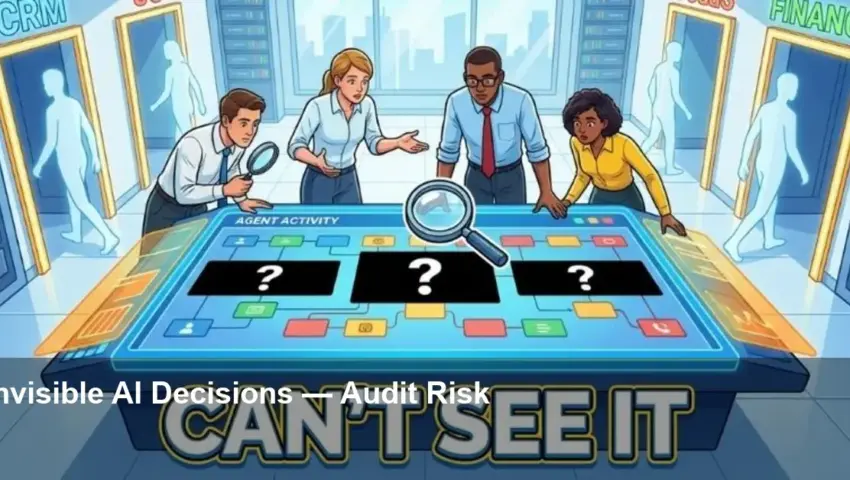
• AI agents act across systems at machine speed, creating decisions that can be invisible to teams.
• Traditional monitoring (metrics, logs) often misses intent, provenance and cross-system action chains.
• AI observability captures intent, action traces and metadata so organizations can audit, govern and remediate.
• Practical steps: capture immutable traces, surface explainability, enforce policy gates, and keep humans in the loop.
What’s the problem?
AI agents — autonomous models or scripted assistants that act across multiple systems — make and execute decisions far faster than humans. That speed is the point of automation, but it also makes decisions hard to see. Actions can cross databases, APIs, email systems and cloud platforms in seconds, leaving only scattered logs and partial metrics. The result: organizations can’t easily answer basic questions after something goes wrong — who instructed the agent, why it acted, what data it used, and which downstream systems were affected.
Why traditional monitoring fails
Traditional observability focuses on infrastructure telemetry: CPU, latency, error rates and application logs. Those signals are necessary but insufficient for agent-driven automation. They do not record intent, the sequence of high-level actions, decision inputs, or the agent’s policy version. An action that looks like a transient API spike might actually be an automated cascade triggered by a model update or a badly written agent script.
Common blind spots
- No provenance: missing links between input data, model decision and executed effect.
- Fragmented traces: different systems keep separate logs with no unified action timeline.
- Missing context: models’ parameters, prompt history or policy versions aren’t captured in monitoring data.
How to build audit‑ready control
Start by treating observability as a product for automation, not an afterthought. Key elements:
1. Capture immutable action traces
Log every agent interaction as an immutable event that links input, decision, policy/model version, and output. Store traces with tamper-evident techniques and retain them long enough for audits.
2. Record intent and context
Save prompts, parameter settings, data sources used, and confidence scores. This makes later explanations and root-cause analysis possible.
3. Unified tracing across systems
Correlate traces from databases, message queues, APIs and UIs into a single timeline so investigators can replay what happened.
4. Policy gates and human‑in‑the‑loop controls
Enforce approval workflows for high‑risk actions, and provide rollback or hold mechanisms when anomalous behavior is detected.
5. Explainability and test harnesses
Run synthetic scenarios, continuous validation, and red‑team tests against agents. Surface human‑readable explanations for critical decisions.
Why this matters now
Without AI observability, organizations face regulatory, financial and reputational risk. As automation scales, so does the potential blast radius of an undetected error. Conversely, firms that implement strong observability and audit controls gain operational resilience, faster troubleshooting and the ability to prove compliance to auditors and customers.
Adopting these practices doesn’t stop innovation — it makes automation safer and trustworthy. If you’re deploying agents in production, treating their decisions as first‑class, auditable events should be a priority.
Image Referance: https://www.uctoday.com/unified-communications/whos-watching-the-watchers-the-invisible-ai-workforce-that-nobody-can-see/