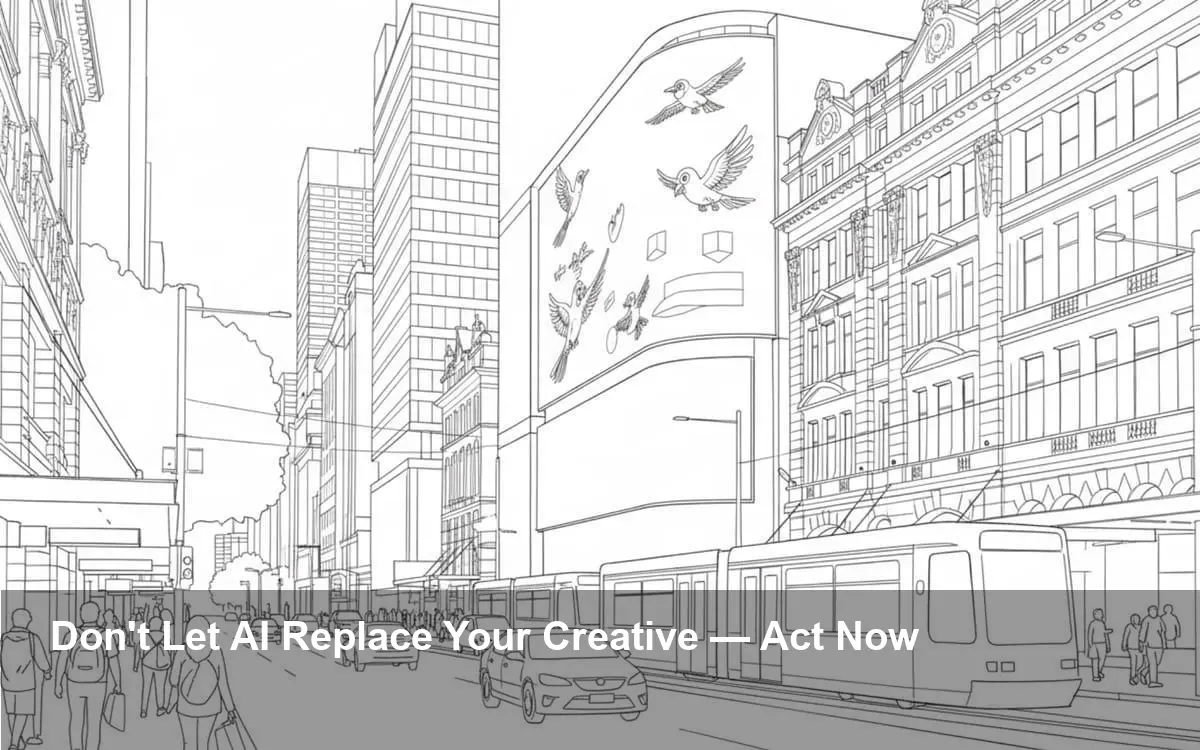
- AI will not replace out-of-home (OOH) creatives by 2026; it will automate planning tasks and unlock new creative opportunity.
- Shawn Spooner predicts AI-driven contextual testing and scale will let teams iterate faster and deliver more relevant OOH work.
- Expect shifts in workflow: fewer manual media tasks, more strategic creative direction, and new measurement and privacy questions.
AI Won’t Replace OOH Creatives — It Will Set Them Free
What Spooner predicts
Shawn Spooner argues that by 2026 artificial intelligence will not eliminate OOH creative jobs but will instead transform how those creatives work. Rather than producing final ads end-to-end, AI will automate time-consuming planning and execution tasks — freeing designers and strategists to focus on higher-order creative problems and contextual storytelling.
How AI will change OOH workflows
Key shifts expected include:
- Automated planning and optimization: AI can handle media allocation, audience prediction and placement logistics more efficiently, reducing manual hours spent on spreadsheets and back-and-forth.
- Contextual testing at scale: Systems will enable many rapid variants of headlines, imagery and messaging to be tested across locations and moments, revealing what works in each context.
- Dynamic, relevant creatives: When combined with data signals (weather, events, footfall), creative assets can be tailored and deployed more responsively than before.
- Faster iteration cycles: With production bottlenecks eased, teams can iterate on ideas quickly, turning insights into new executions within days instead of weeks.
Benefits for brands and creative teams
For brands, the upside is stronger performance and better use of media spend through smarter placement and rapid validation of creative hypotheses. For creatives, the benefit is time: by offloading repetitive tasks, AI gives them space to experiment, craft more resonant campaigns, and collaborate earlier with strategy and data teams.
Risks and challenges
AI-driven change brings risks. Measurement frameworks for OOH will need to evolve to capture contextual wins. Privacy and data governance will be central as more signals are used to tailor outdoor messages. And there’s a cultural shift: organizations must trust creative teams to use data without letting algorithms dictate all choices.
What brands should do now
- Invest in tooling and training that fuses creative and data workflows — not isolated stacks.
- Run pilot programs focused on contextual testing to learn fast and build internal confidence.
- Establish clear measurement and privacy guardrails before scaling dynamic deployments.
- Protect time for intentional creative thinking: automation should free people, not replace them.
In short, Spooner’s view reframes AI as a liberator for OOH creatives rather than an existential threat. The smart brands will treat 2026 as a turning point: adopt automation to remove friction, then double down on human-led creative strategy to exploit the greater speed and scale AI enables.
Image Referance: https://ppc.land/ai-wont-replace-ooh-creatives-in-2026-it-will-finally-set-them-free/