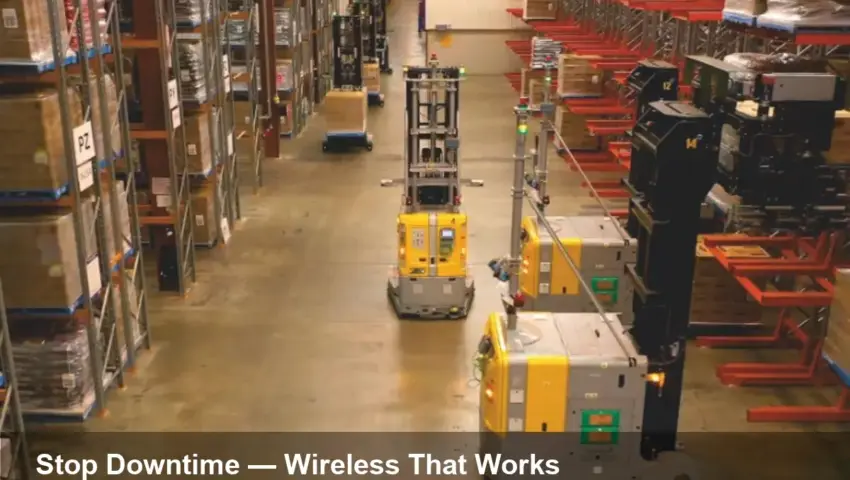
- Cisco URWB delivers wireless reliability and operational simplicity for industrial AI and automation.
- Companies such as E80 and Planet Farms are cited as examples using the solution.
- The platform is designed to reduce deployment complexity and risk of downtime for factory-floor systems.
- IT and OT teams can accelerate AI and automation projects by simplifying network operations.
What Cisco URWB does
Cisco URWB is presented as a wireless solution aimed at industrial environments where AI and automation are expanding rapidly. According to the announcement, the technology focuses on delivering reliable wireless connectivity while keeping operational complexity low — a combination that manufacturers and automation integrators increasingly demand.
The core message is simple: provide wireless that operations teams can trust, so AI workloads, sensors, robots and control systems can be deployed without the friction and cost of extensive cabling or lengthy network rework.
Why this matters for industrial AI and automation
Industrial AI and automated systems depend on consistent, low‑latency data flows and predictable network behavior. When wireless connectivity is unreliable or hard to manage, projects stall, maintenance costs climb and downtime risks increase. Cisco URWB aims to reduce those barriers by focusing on reliability and operational simplicity — two attributes that directly affect the speed and success of factory AI rollouts.
For businesses deploying machine learning models at the edge, vision systems for quality control, autonomous mobile robots (AMRs), or distributed sensor networks, a simpler, more dependable wireless fabric can mean faster proof‑of‑concepts and quicker scaling to full production.
Real-world examples: E80 and Planet Farms
The announcement highlights E80 and Planet Farms as examples of organizations deploying the solution. While specifics about each deployment are not detailed here, these mentions serve as early social proof that manufacturers and modern agriculture operations are exploring wireless-first approaches for automation and AI.
Seeing peers and sector specialists adopt a new networking approach creates FOMO for teams still tied to legacy wired architectures: if others are moving faster with fewer headaches, it’s worth evaluating the same for your facilities.
What industrial teams should consider next
- Pilot before a full rollout: validate performance with your actual AI workloads and AMR patterns.
- Involve OT and IT early: alignment between control engineers and network teams reduces integration surprises.
- Prioritize security and manageability: operational simplicity should include clear tools for monitoring and updating devices.
- Measure real impact: track deployment speed, downtime incidents and maintenance hours before and after switching to wireless.
Bottom line
Cisco URWB positions itself as a wireless option for organizations ready to accelerate industrial AI and automation without adding network complexity. With early examples like E80 and Planet Farms referenced, manufacturing and controlled‑environment agriculture teams should consider pilots to see whether a wireless‑first approach lowers cost, reduces downtime risk and speeds up AI adoption on the factory floor.
Image Referance: https://blogs.cisco.com/industrial-iot/cisco-urwb-powering-industrial-ai-and-automation-on-the-factory-floor